
Online FWA Training for Healthcare Employees, Providers, Health Plans, and Contractors
Learn how to prevent, detect, report, and correct healthcare fraud, waste, and abuse. Supremus Group’s Healthcare Fraud, Waste & Abuse Prevention Training connects federal compliance topics to everyday decisions about patient care, documentation, claims, referrals, and payments. The course helps healthcare professionals and support staff recognize potential concerns, work accurately, and understand when to seek guidance or report a problem.
The online, self-paced course includes 120 slides organized into 12 modules, with narrated instruction, practical examples, and fictional workplace scenarios followed by explanations. It covers Medicare and Medicaid fraud, waste, and abuse while also addressing risks across broader healthcare operations. Learners practice evaluating situations, choosing appropriate responses, and understanding how their daily responsibilities support patient safety and accurate payment.
Course Details at a Glance
| Course Detail | Information |
|---|---|
| Course name | Healthcare Fraud, Waste & Abuse Prevention Training |
| Training provider | Supremus Group LLC |
| Price | $25 per learner |
| Format | Online, self-paced training with audio |
| Course structure | 120 slides organized into 12 modules |
| Learning activities | Lessons, practical examples, fictional scenarios, and response explanations |
| Assessment | Course knowledge assessment |
| Online access | After 60 days, or once you start the test, whichever comes first, you will no longer have access to the course. |
| License | Single learner |
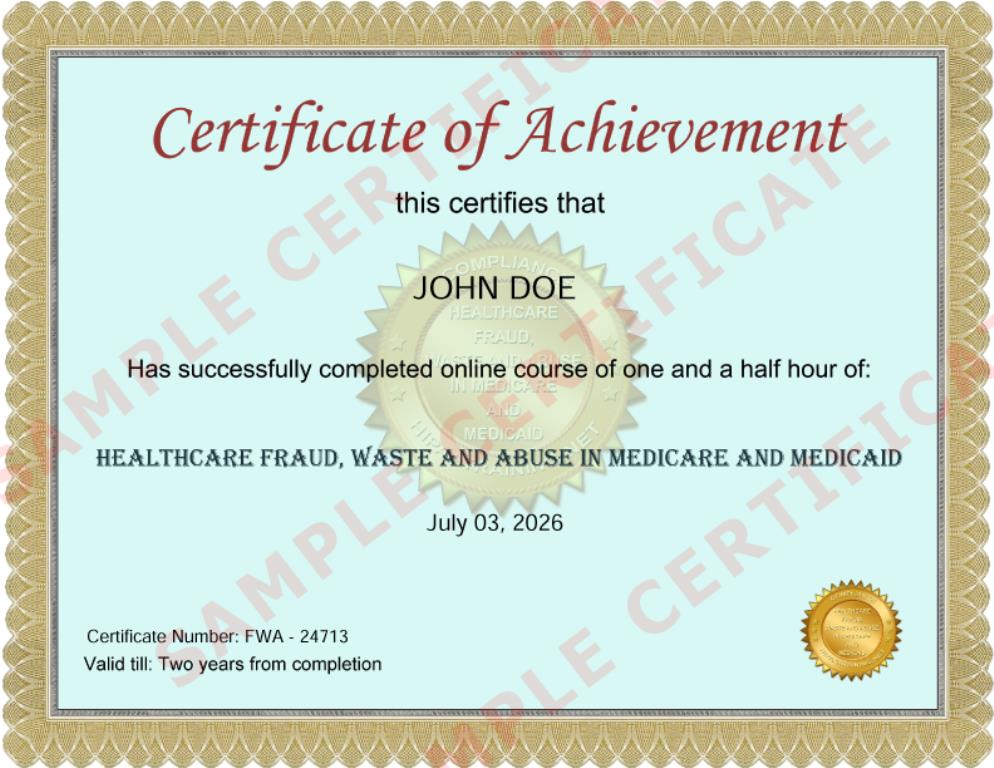
| Completion document | Certificate of Completion after meeting course requirements |
| Certificate term | One year under the course’s certificate policy |
The certificate term is separate from any training schedule required by an employer, health plan, contract, or applicable law.
Who Should Take This FWA Training?
This course is designed for people whose work affects healthcare services, records, claims, purchasing, payments, or compliance. It addresses responsibilities across clinical, administrative, management, and contractor roles.
Clinical and patient-care teams: Physicians, nurses, therapists, pharmacists, clinical support staff, and other professionals involved in providing or documenting care.
Billing, administrative, and financial teams: Medical billers, coders, claims staff, registration employees, practice administrators, finance staff, and purchasing personnel.
Healthcare leaders and contractors: Compliance personnel, managers, supervisors, health plan staff, billing vendors, and relevant service providers.
Examples cover hospitals, medical practices, home health, hospice, nursing facilities, rehabilitation, behavioral health, pharmacies, laboratories, equipment suppliers, healthcare transportation, medical courier services, and health plans. The course distinguishes the rules for different settings rather than treating every service or payer the same.
What Will You Learn?
After completing Healthcare Fraud, Waste & Abuse Prevention Training, learners should be able to:
- Distinguish fraud, waste, abuse, and ordinary errors. Understand how these concepts differ and why an incorrect claim or improper payment does not automatically prove fraud. Recognize the importance of checking facts, considering the circumstances, and reporting concerns without making unsupported accusations.
- Recognize questionable claims and financial arrangements. Identify warning signs such as unsupported billing codes, inaccurate patient records, duplicate claims, improper referral incentives, and charges for services that were never provided. Understand when a concern needs review by billing, clinical, compliance, or legal personnel.
- Support accurate documentation, billing, and payment. Understand why records and claims must reflect the care actually provided, the practitioner’s involvement, and the qualifying time or units billed. Recognize the need to follow applicable payer requirements, clarify incomplete information, and correct errors through approved procedures.
- Report concerns promptly, factually, and securely. Know how to describe a concern, identify relevant records, and use appropriate reporting channels. Preserve information, protect patient privacy, and stay within your authorized role rather than conducting an independent investigation. Understand that you do not need to prove fraud before reporting a concern.
- Support corrective action and prevent recurring problems. Recognize possible overpayments and escalate them for timely review. Understand why correction should address both the immediate issue and its underlying cause. Identify related risks involving patient information, identity misuse, outsourced services, and inaccurate AI-generated documentation.
What Is Healthcare Fraud, Waste, and Abuse?
Healthcare fraud generally involves deception or misrepresentation to obtain an improper benefit. Examples include deliberately billing for a visit that never occurred or creating false documentation to support payment. Different laws have different requirements for establishing a violation.
Healthcare waste involves avoidable use of healthcare resources. Examples include unnecessary duplication, inefficient processes, and supplies that expire before use. Clinical context matters: repeating a test may be appropriate when a patient’s condition changes or an earlier result is unreliable.
Healthcare abuse involves practices inconsistent with sound fiscal, business, or medical standards that create unnecessary costs or improper reimbursement. Examples may include inappropriate coding practices or services that lack the required medical necessity.
An honest error is not automatically fraud. However, ignoring credible information that claims are inaccurate can create additional risk. The civil False Claims Act’s knowledge standard includes actual knowledge, deliberate ignorance, and reckless disregard; it does not require proof of a specific intent to defraud. Staff should report the facts rather than attempt to decide every legal element themselves.
Healthcare FWA Training Course Outline
Module 1: FWA Foundations
Understand fraud, waste, abuse, and ordinary errors. Explore how these issues affect patients and payment, and practice a safe response: check the facts, protect patients, preserve records, and report concerns.
Module 2: Laws and Obligations
Review the False Claims Act, Anti-Kickback Statute, Stark Law, exclusion risks, and protections for lawful reporting. Learn why gifts, referrals, and financial relationships may need review under more than one law.
Module 3: Documentation and Billing
Follow the process from actual care to the final claim. Review documentation, practitioner involvement, time and units, supported coding, truthful corrections, and payment reconciliation. Learn to address recurring problems instead of correcting only one account.
Module 4: Risks Across Healthcare Settings
Examine service-specific risks across hospitals, outpatient care, home health, pharmacies, transportation, health plans, and other settings. Review eligibility, clinical need, actual service delivery, and the importance of protecting appropriate care during billing reviews.
Module 5: Financial and Digital Workflows
Review conflicts of interest, gifts, patient assistance, vendors, invoices, and banking changes. Explore telehealth and remote-monitoring examples that connect payment to the actual qualifying services performed.
Module 6: Recognizing Warning Signs
Identify verifiable discrepancies without relying on patient stereotypes. Learn how to interpret unusual patterns and analytics, respond to patient questions, and coordinate reviews involving possible medical identity theft.
Module 7: An Effective Compliance Program
Explore the seven compliance-program elements, including policies, leadership, training, communication, fair standards, risk assessment, auditing, monitoring, and corrective action. Learn why training is one part of an effective program rather than a substitute for the entire program.
Module 8: Reporting and Responding
Practice prompt, factual, and secure reporting. Review evidence preservation, authorized access, patient protection, and nonretaliation. Understand why reporting a concern does not require proving fraud first.
Module 9: Overpayment Response
Recognize possible overpayments and the need for timely escalation. Review the Medicare Parts A and B framework, payer differences, investigation conditions, repayment review, and correcting the underlying cause. Learn why one refund may not resolve the full problem.
Module 10: Privacy and Identity Safeguards
Connect HIPAA and identity safeguards to FWA prevention. Review the difference between HIPAA roles and Medicare contracting terms, FTC Red Flags Rule applicability, record-specific retention, and preservation holds.
Module 11: Brief AI Awareness
Learn to verify AI-generated documentation against the actual encounter before signing or billing. Review approved tools, permitted information, correction of false content, and reporting recurring defects. This is a focused FWA awareness section, not a full AI compliance course.
Module 12: Putting the Course into Practice
Connect daily responsibilities to controls that protect patients, records, and payments. Apply the course to a combined scenario and reinforce four actions: prevent, detect, report, and correct.
Practice With Healthcare Workplace Scenarios
The course uses fictional scenarios to help learners choose an appropriate next step before reviewing the explanation. The exercises focus on decisions employees may face, not simply memorizing definitions.
How This Course Supports Your Compliance Program
The course provides a shared foundation for employees and managers to recognize risks, ask questions, and respond to concerns. Organizations can use it within onboarding, compliance education, or refresher programs after confirming that it fits their requirements.
Pair the course with local orientation covering your organization’s reporting contacts, approved forms, documentation standards, payer requirements, and escalation procedures. Employees should know where to report an urgent patient-safety issue, a questionable claim, a possible overpayment, or suspected retaliation.
Training is one part of a broader compliance program. Effective oversight also involves usable policies, responsible leadership, monitoring, auditing, and corrective action. HHS OIG’s General Compliance Program Guidance is voluntary; separate laws, regulations, and contracts may impose specific obligations.
Frequently Asked Questions
Enroll in Healthcare Fraud, Waste & Abuse Prevention Training
Build the knowledge to recognize questionable practices, support accurate healthcare records and payments, and report concerns responsibly.
$25 per learner | Online, self-paced | 60 days of access | Certificate of Completion
Register for Healthcare FWA Prevention Training
For questions about the course or enrolling your team, email Bob@hipaatraining.net or call 515-865-4591.
This course provides general education and does not replace legal advice, payer-specific instructions, or your organization’s policies and procedures.
Certificate for Continuing Education Credits:
Students can buy a 1.5 CE credits certificate for this course at the time of registration. You will receive one CE credit for this course through the Approved Provider of California Board of Registered Nursing after completing the course.
Email us now at Bob@hipaatraining.net or call (515) 865-4591 if you have any questions about Medicare Fraud Waste and Abuse training course and who should take this course.
Testimonials
This course is very helpful. I will recommend it to anyone who would like to take a course about Medicare/Medicaid Fraud, Waste, Abuse.
Natacha Charles
It was a great experience I appreciate the opportunity to take the test I have also encouraged our colleagues in the industry to take the test.
Kelvin Jones
Very interesting course. I have been in this industry for 30 years. good test.
Nancy H.
Thank you! I learned a lot that can benefit me educating those I work with.
Sarah Zayhowski
Very Informative Course. I would recommend.
Armando Torres
Barkley Risk Management & Insurance
Interesting course that shows what healthcare fraud, waste and abuse in medicare and medicaid is.
Kristen R
This was very informational and helpful.
KRISTINA MARINO
Great information in a convenient format
CHARLES SIGUENZA
Good review of these regulations. Thank you!
Rita Eng
Well conducted course. Easy to understand and complete.
Hallie Zwibel
This is very good training to review once a year.
Derek Kunc
Very enlightening, thank you once again
Oscar Smith
Very useful info. Informative, and I can trust it is accurate.
Dorothea Moore
This course was great and helped me a lot!
Wesue Harmon
Great course, covered it all. Thanks
Susan Fette
USER RATING:
Medical Fraud, Waste and Abuse Training Course for Medicare/Medicaid is rated 4.7 out of 5 by 1618 users.