AI Awareness Training for Employees
AI Awareness Training for Employees is a practical, non-technical course designed to build everyday judgment for using AI responsibly at work—so teams move faster without sacrificing accuracy, privacy, fairness, or trust. AI is now embedded in everyday workplace tools—writing assistants, search features, analytics helpers, meeting summaries, customer chat, and workflow automation. It can accelerate great work, but it can also scale mistakes quickly when people over-trust outputs, paste sensitive data into the wrong tool, or use AI in high-impact decisions without the right checks.
What is AI?
Artificial Intelligence (AI) refers to computer systems that perform tasks we often associate with human intelligence—such as recognizing patterns, generating language, classifying information, or making predictions.
How modern AI works (plain language)
Most workplace AI tools (especially generative AI) produce outputs by learning statistical patterns from large datasets and generating a “best-fit” response to your prompt. That means AI can sound confident and polished even when it’s incorrect, incomplete, or missing context.
What AI is not
AI is not conscious and does not “understand” information the way people do. It doesn’t have judgment, ethics, or intent. It can’t reliably determine what’s appropriate, compliant, or fair unless humans provide guardrails and review.
Treat AI output as a draft or suggestion—not a verified answer.
In accordance with Section 2054.5193 of the Government Code, the Texas Department of Information Resources (DIR) has reviewed our Artificial Intelligence (AI) awareness training and determined that it meets the required criteria. It is hereby certified for state and local government employees, as well as their vendors and contractors.
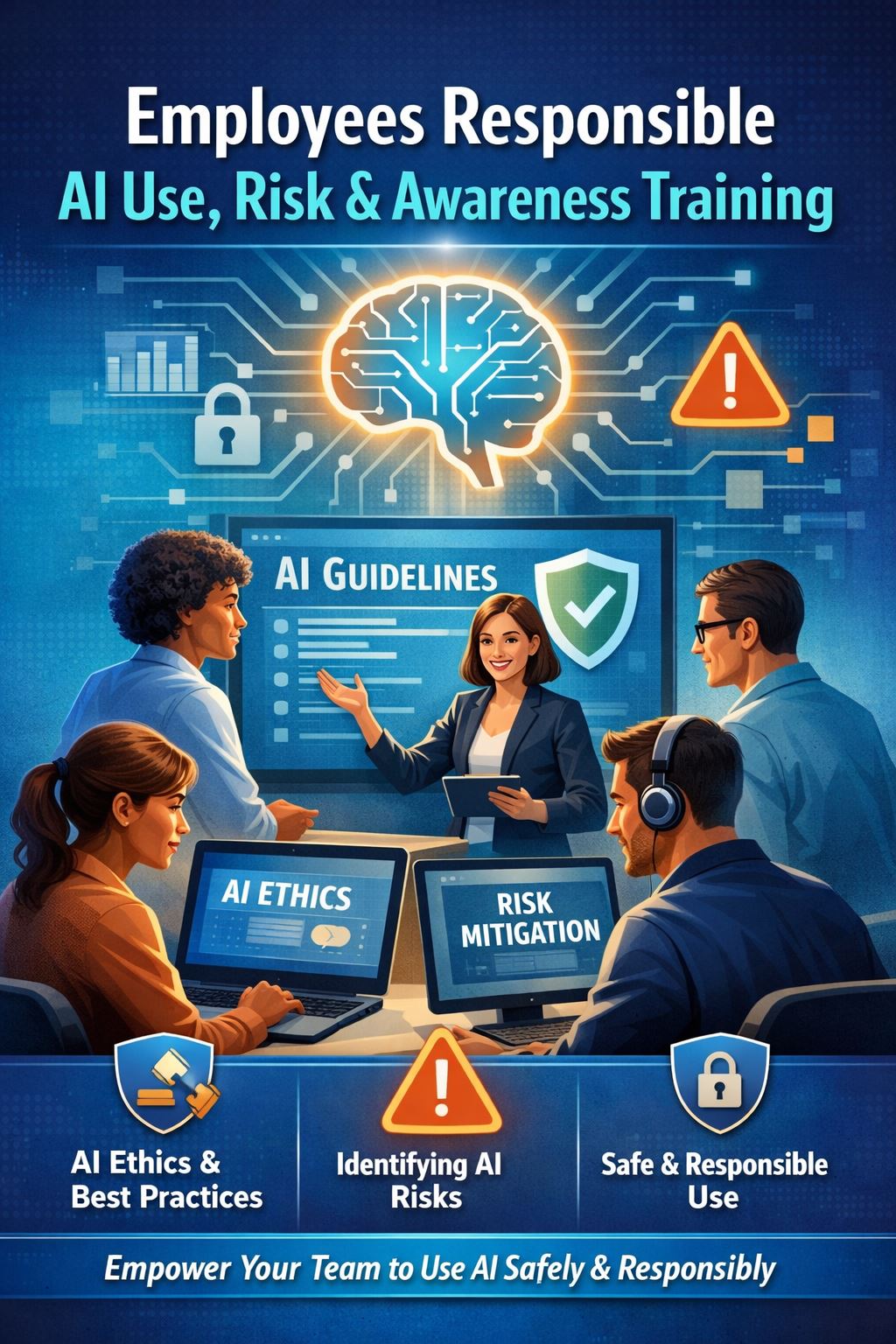
Why AI Awareness Training Matters
Without consistent AI awareness across a workforce, organizations often see the same failure patterns repeat:
- People assume AI is correct because the output sounds authoritative
- Sensitive information is pasted into unapproved tools
- AI summaries change meaning or omit critical context
- Bias slips into recommendations and language
- Automation hides errors until they spread across many cases
- Teams use “shadow AI” (unapproved tools) to move faster—creating data exposure and compliance risk
This training exists to build shared expectations and repeatable habits that prevent these issues—while still enabling productivity gains.
Who should take this training?
This course is designed for employees across roles, departments, and industries, including people with no technical background. It’s especially relevant for:
- All employees using AI directly (chat tools, copilots, writing assistants, analytics assistants)
- Teams using tools where AI is “built-in” (email, document suites, CRM, ticketing platforms, meeting tools)
- People managers who approve work and need consistent review expectations
- HR, recruiting, and people operations (high sensitivity and fairness considerations)
- Customer service, sales, and support (external communication and trust impact)
- Marketing and communications (accuracy, claims, brand voice, disclosure)
- Finance, operations, and analytics (decision-support, trend interpretation, monitoring)
- IT, security, privacy, compliance, legal (governance, tool approvals, risk controls)
If AI touches your workflow—or your workflow affects customers, employees, decisions, or data—this training is for you.
Objectives of AI Awareness Training for Employees
By the end of this course, learners will be able to:
- Explain what AI is (and isn’t) in plain language and why that matters for responsible use
- Recognize common workplace AI use cases (drafting, summarizing, analysis, automation, chatbots)
- Identify core limitations and risks: accuracy failures, hallucinations, bias, missing context, over-reliance
- Use AI tools responsibly by choosing approved tools and avoiding “shadow AI”
- Protect privacy and security by minimizing, anonymizing, and avoiding sensitive inputs
- Apply a risk-based approach: scale safeguards based on impact and data sensitivity
- Practice human oversight and accountability: verify load-bearing facts, apply judgment, document decisions
- Understand transparency expectations (especially when AI influences outputs users rely on)
- Spot high-risk / restricted use cases and know when to pause and escalate to the right team
All learning is focused on practical workplace behavior, not model-building or engineering.
Course Overview:
- Total Course Duration: 1.5 Hours
- Audio: Yes
- Number of Total Slides: 99 slides
- Online course login expires in: 2 months from receiving the login details. You will not have access to online content after you complete the course.
- Certificate valid for: 2 Years
- Type of License: One user license cannot be transferred after login is assigned.
What the training covers?
Module-based curriculum (high-level)
- Module 1: What is AI?
Shared definitions, common misconceptions, how AI generates outputs, strengths vs limitations - Module 2: How AI is used at work
Drafting, summarizing, analysis, automation, and public-facing chatbots—plus guardrails - Module 3: AI tools & authorization
Why tool choice matters, approved vs unapproved tools, “shadow AI” risk, data handling differences - Module 4: Acceptable use & governance
How organizations set boundaries, when to escalate, why governance protects employees - Module 5: Risks & limitations
Accuracy/reliability, bias/data quality, lack of context/judgment, automation bias, “risk increases with impact” - Module 6: Legal & prohibited / highly restricted uses
AI doesn’t remove legal responsibility; red-flag use cases (surveillance-like monitoring, profiling, sensitive data misuse, people-impacting decisions) - Module 7: Risk-based AI use
Simple risk lens: impact + data sensitivity + reversibility; low/medium/high risk examples and safeguards - Module 8: Human oversight & accountability
Human-in-the-loop expectations, “the tool said so” is not defensible, documentation practices - Module 9: Privacy & security
Prompt hygiene, what never to enter, anonymization, credential protection, AI-enabled phishing awareness - Module 10: Transparency & trust
AI-assisted vs AI-made outcomes, user notices for chatbots, proportional disclosure - Module 11: Accuracy, monitoring & review
Verification routines, drift monitoring, continuous improvement in prompts and workflows - Module 12: Ethical AI in practice
Fairness/accountability/transparency applied to scenarios; pause–review–escalate–document framework - Module 13: Knowledge check
Realistic judgment practice to reinforce safe habits
Benefits of taking this training
Benefits for employees
- Use AI with confidence (without risky shortcuts): Understand when AI is helpful and when it’s dangerous
- Avoid common career-risk mistakes: Sharing sensitive data, sending unverified AI text externally, relying on biased outputs
- Make better decisions faster: Use AI for drafts and options while keeping judgment human
- Know what to do when unsure: Clear “pause and escalate” triggers reduce guesswork
Benefits for organizations
- Reduce preventable incidents tied to privacy, data leakage, inaccurate communications, or policy misuse
- Create consistent AI expectations across teams so quality and accountability don’t vary by department
- Improve compliance readiness by reinforcing tool authorization, documentation, and oversight habits
- Protect brand trust and customer experience with stronger review, transparency, and escalation patterns
- Enable responsible AI adoption by moving from ad-hoc usage to shared norms and guardrails
What learners can do after the course
Participants leave with practical, repeatable habits they can apply immediately:
A simple “responsible AI” checklist
- Is this the right (approved) tool for this task?
- Am I avoiding sensitive inputs or using placeholders/anonymization?
- What are the load-bearing claims (names, numbers, dates, commitments)? Did I verify them?
- Does the output fit the audience, tone, and policy expectations?
- If this is wrong, what happens next—and should I escalate?
- Do I need to document my checks and edits?
FAQs
1) Is this training technical?
No. It’s designed for non-technical employees. The focus is safe workplace judgment, not building AI systems.
2) Do employees need prior AI experience?
No. It starts with a plain-language foundation and builds up to practical scenarios.
3) Is this training only for people who use generative AI chat tools?
No. It also applies when AI is embedded in everyday software (email, documents, CRM, ticketing, meeting tools, analytics).
4) What’s the biggest risk this training helps prevent?
Over-reliance (treating AI as automatically correct) and unsafe data sharing (pasting sensitive content into the wrong tool) are two of the most common preventable risks addressed.
5) What does “human oversight” mean in practice?
Reviewing AI outputs before use: verifying key facts, checking assumptions, ensuring tone and context fit, and making sure the final decision stays human-owned.
6) Does it cover AI bias and fairness?
Yes. Learners are taught how bias can appear through data patterns and why humans must actively check fairness—especially when people are affected.
7) Does it address privacy and security?
Yes. It teaches prompt hygiene, what should never be entered (identifiers, credentials, confidential details), and safer approaches (minimize, redact, anonymize, use approved tools).
8) What are “approved tools,” and why does it matter?
Organizations often approve tools based on data handling, retention, and security controls. Using unapproved tools (“shadow AI”) can create privacy, confidentiality, and compliance exposure even if output quality seems good.
9) Does this training provide guidance on “high-risk” AI uses?
Yes. It explains that risk depends on impact and sensitivity—especially when outputs influence decisions about people, eligibility, access, benefits, employment outcomes, or regulated obligations.
USER RATING:
Responsible AI Use, Risk & Awareness Training is rated 4.9 out of 5 by 306 users.