Comprehensive Latex Allergy Training: Your Essential Guide to Safety, Compliance, and Prevention in Healthcare
In the fast-paced, high-stakes environment of modern healthcare, few occupational hazards carry the dual threat of being both commonplace and potentially fatal. Natural Rubber Latex (NRL) allergy represents precisely this kind of insidious danger. It’s not a niche concern or a rare condition—it’s a pervasive risk embedded in the very tools of the trade: gloves, catheters, tubing, and countless other medical devices. For healthcare professionals, from surgeons and nurses to laboratory technicians and environmental staff, latex isn’t just an allergen; it’s a daily occupational hazard with the power to trigger reactions ranging from debilitating dermatitis to swift, life-threatening anaphylaxis.
The landscape of latex allergy is fraught with complexity. It’s governed by a stringent web of federal regulations from the FDA, OSHA, and the CDC. It requires a nuanced understanding of immunology to distinguish between a mild irritation and a systemic emergency. Most critically, it demands a proactive, institution-wide culture of safety to protect the most vulnerable: both the dedicated healthcare workforce and the patients who rely on their care. This is not knowledge that can be left to chance or assumed. It must be taught, reinforced, and ingrained in practice.
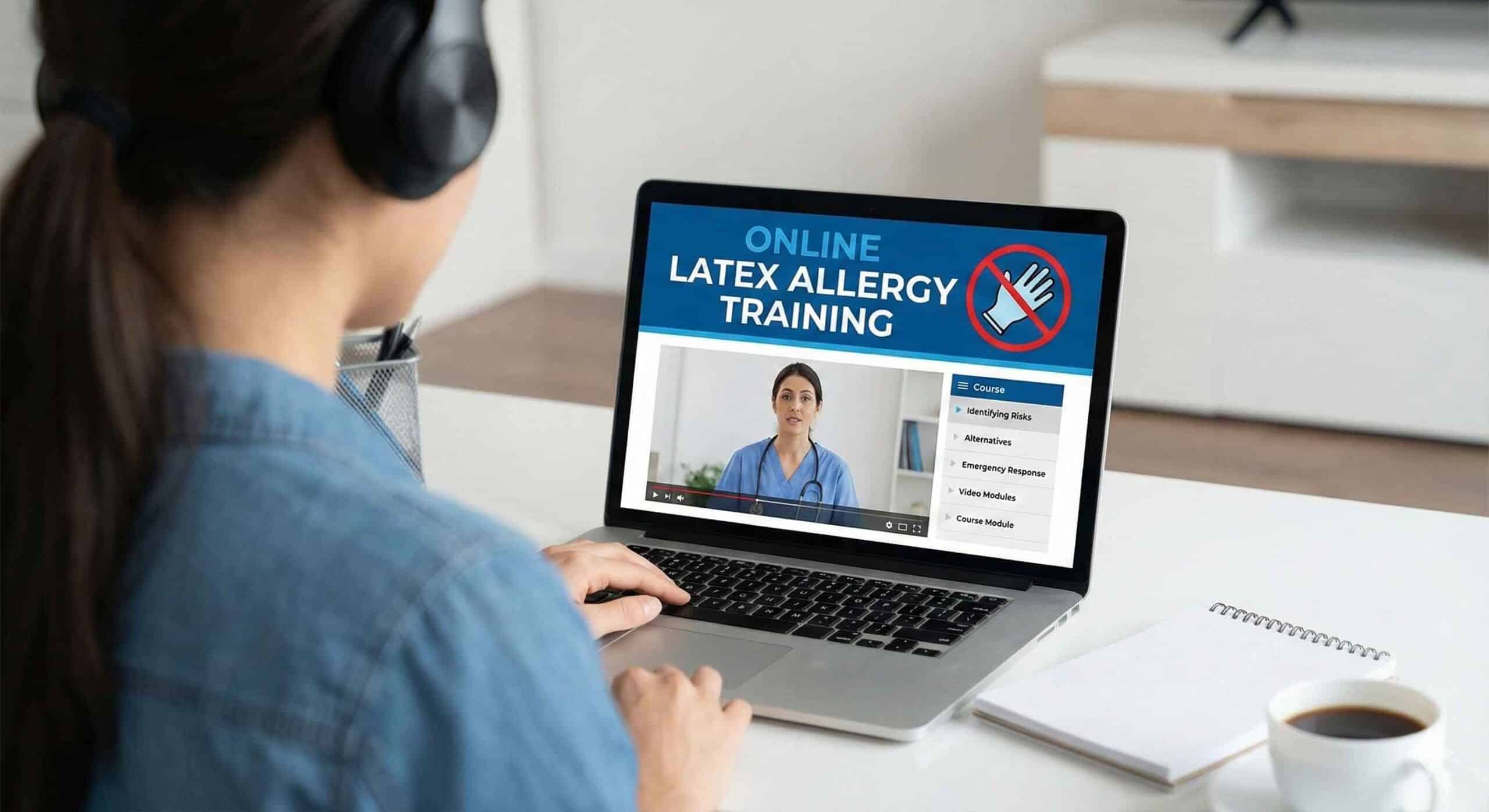
This is why we have developed our premier Online Latex Allergy Awareness and Regulatory Compliance Course—a comprehensive, actionable, and compliance-focused training program designed to transform awareness into executable safety. This isn’t just another checkbox for annual training. This is a deep dive into the science, strategy, and protocols that form the bedrock of a truly latex-safe environment.
The Stakes Have Never Been Higher: Understanding the Latex Allergy Crisis
To understand the critical need for this training, one must first grasp the scope of the problem. While only 1-6% of the general population has a latex sensitivity, the numbers skyrocket in healthcare settings. Prevalence among healthcare workers ranges from 10% to 17%, with those in high-exposure roles like surgery, dentistry, and emergency medicine at the greatest risk. This isn’t a coincidence; it’s a direct consequence of occupational exposure.
The primary driver? Repeated contact with latex proteins, often through the very personal protective equipment (PPE) meant to ensure safety. For years, powdered latex gloves were the worst offender, aerosolizing allergenic proteins that could be inhaled by anyone in the room, leading to silent sensitization and the sudden onset of severe asthma or anaphylaxis after years of seemingly unaffected work. While the FDA’s 2017 ban on powdered latex gloves was a landmark victory for public health, it did not eliminate the risk. The healthcare system now manages a legacy population of sensitized workers and patients, while supply chain fluctuations can still introduce non-compliant or poorly labeled latex products.
The consequences of inadequate training are severe:
For Staff: Chronic occupational asthma, disabling contact dermatitis, and the ever-present risk of an acute anaphylactic event during a procedure.
For Patients: Catastrophic allergic reactions during surgery or routine care, particularly for high-risk groups like patients with spina bifida (who have a sensitization rate exceeding 60%) or those with multiple prior surgeries.
For Institutions: Major OSHA violations, Joint Commission citations, devastating malpractice lawsuits, and a corrosive erosion of staff trust and patient safety culture.
The question is no longer if your facility needs rigorous latex allergy training, but how you will implement it effectively, consistently, and in full compliance with the law.
Beyond Basic Awareness: A Curriculum Built for Clinical Reality
Our course moves far beyond simple definitions. It is structured as a strategic journey from foundational knowledge to emergency mastery, ensuring every learner finishes not just informed, but empowered.
Module 1: Introduction & Overview
Defining Natural Rubber Latex
Prevalence Data in the US
Reaction Type 1: Immediate Hypersensitivity (Type I)
Reaction Types 2 & 3: Dermatitis
Module 2: Causes & Risk Factors
Etiology: The Allergen
Exposure Route: Airborne Inhalation
High-Risk Occupations
Patient Risk Factors: Medical History
Cross-Reactivity (The Food Connection)
Module 3: Symptoms & Diagnosis
Mild and Moderate Symptoms
Severe Systemic Symptoms (Anaphylaxis)
Case Study 1 – Nurse in the OR
Diagnosis: Clinical History is Key
Diagnosis: Laboratory Confirmation
Module 4: Prevention & Management
Core Strategy: Substitution
Core Strategy: Elimination
Safe Practices: Hand Care
Safe Practices: Inventory & Labeling
Setting Up Latex-Free Zones
Supply Chain & Procurement
Pre-Procedure Screening
Communication with Patients & Families
Action for Mild Reactions
Action for Severe Reactions and Reporting
Anaphylaxis: Immediate Steps
Anaphylaxis: Epinephrine Auto-Injector Use
Anaphylaxis: Post-Epi Care
Module 5: Regulatory & Compliance
Supervisor Role in Latex Allergy Safety
Americans with Disabilities Act (ADA) Compliance
Audit Preparation Checklist
Patient Identification Protocols
Employee Training & Kits
Summary of Regulatory Agency Roles
Fostering a Safety Culture
Module 6: Summary & Knowledge Reinforcement
After a Latex Reaction
Return-to-Work Protocols
Emergency Flowchart (Visual Aid)
Quick Reference Checklist
Key Takeaways: Prevention & Risk
Key Takeaways: Emergency & Compliance
Course Conclusion
Course Overview:
Total Course Duration: 30 minutes
Audio: Yes
Number of Total Slides: 50 slides
Online course login expires in: 2 months from receiving the login details. You will not have access to online content after you complete the course.
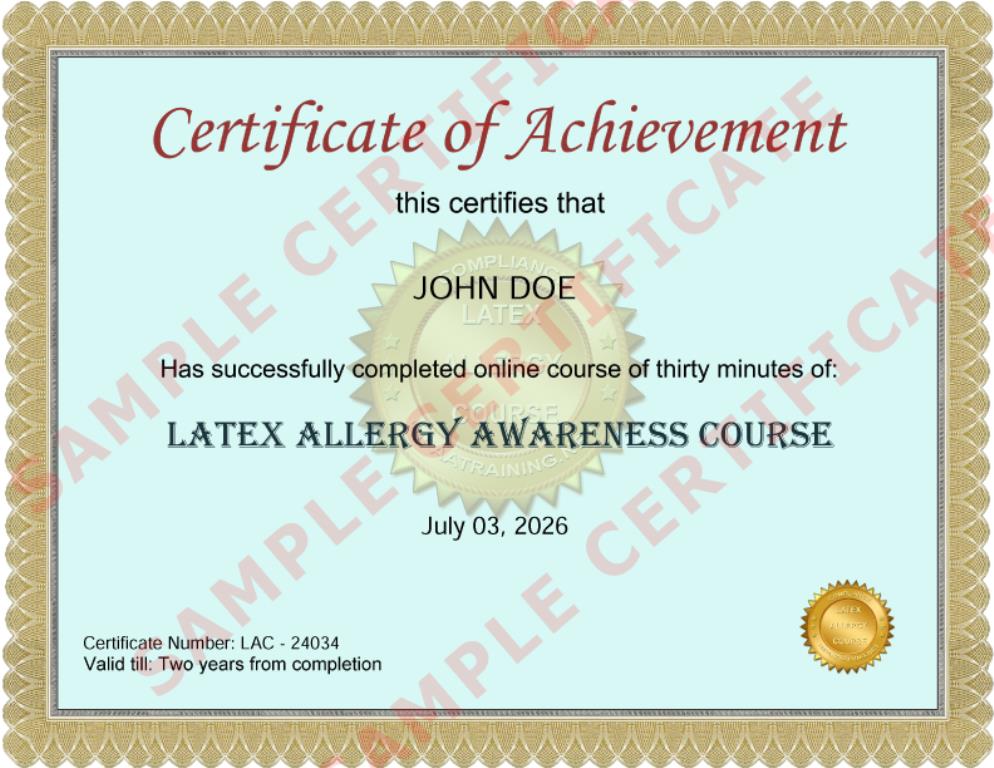
Certificate valid for: 2 Years
Type of License: One user license cannot be transferred after login is assigned.
Why Our Online Course is the Definitive Solution
In a sector plagued by time constraints and staffing shortages, our course delivers maximum impact with minimum disruption.
Comprehensive & Current: We synthesize the latest guidelines from the FDA, OSHA, CDC, and leading allergology bodies into a single, up-to-date curriculum.
Deeply Engaging: This is not a passive slideshow. It uses real-world scenarios, interactive knowledge checks, and practical tools that learners can immediately apply.
Designed for Retention: Modular design allows for flexible, self-paced learning that fits into busy schedules, improving comprehension and long-term knowledge retention compared to one-off seminars.
Accountability & Documentation: Automated tracking and reporting provide administrators with clear records of completion—essential for regulatory audits and demonstrating due diligence.
Scalable & Cost-Effective: From a small clinic to a multi-hospital system, our platform delivers consistent, high-quality training to every team member without the cost of travel or lost clinical hours.
Invest in Safety, Compliance, and Peace of Mind
Choosing our Latex Allergy Awareness and Regulatory Compliance Course is more than an educational purchase; it’s a strategic investment in your organization’s most valuable assets.
You are investing in:
Your People: Protecting their health, longevity, and ability to work safely.
Your Patients: Upholding the highest standard of care and preventing preventable harm.
Your Reputation: Demonstrating an unwavering commitment to safety that attracts top talent and patient trust.
Your Compliance: Building an audit-ready, defensible safety program that mitigates legal and financial risk.
Don’t wait for an incident to reveal the gaps in your latex safety protocol. Proactive education is the most powerful tool for prevention.
Equip your entire team with the knowledge to recognize the risk, the protocols to eliminate it, and the confidence to respond when seconds count.