
Protecting Healthcare Workers, Patients & Communities

Tuberculosis (TB) remains one of the most serious airborne infectious diseases worldwide. This comprehensive TB Transmission Prevention Training equips healthcare and congregate-setting personnel with the knowledge, skills, and regulatory awareness required to prevent the spread of TB in clinical and community environments.
Built on the latest CDC guidelines and OSHA respiratory protection standards, this training provides practical instruction on recognizing TB risks, applying layered infection control strategies, and maintaining full regulatory compliance while safeguarding staff and patients.
Course Overview
This interactive training delivers a complete understanding of:
-
How TB spreads through airborne transmission
-
The critical difference between Latent TB Infection (LTBI) and active TB disease
-
How to apply the Hierarchy of Controls for effective prevention
-
Proper use of N95 respirators and OSHA respiratory protection requirements
-
Environmental safeguards such as AIIR rooms, ventilation, HEPA filtration, and UVGI
-
Screening, documentation, reporting, and post-exposure response procedures
Participants leave the course confident in their ability to prevent TB transmission in real-world healthcare settings.
Who Should Take This Course?
This training is essential for:
-
Healthcare workers
-
Medical laboratory personnel
-
Emergency responders
-
Home health providers
-
Long-term care and correctional facility staff
-
Infection control teams
-
Environmental services personnel
-
Occupational health & safety officers
Any employee who may encounter individuals or specimens where Mycobacterium tuberculosis could be present will benefit from this training
What You Will Learn
1. TB Fundamentals & Transmission
Participants will learn:
-
What causes TB and how it spreads through airborne droplet nuclei
-
Key symptoms of active pulmonary TB
-
Risk factors related to the infectious person, environment, and exposed individual
-
The growing challenge of MDR-TB and XDR-TB
2. The Hierarchy of Controls
This course teaches the three-layer prevention framework used in U.S. healthcare:
Administrative Controls
-
Rapid identification & isolation of suspected TB cases
-
TB risk assessments & written infection control plans
-
Patient screening, reporting & public health coordination
Environmental Controls
-
Ventilation principles and airflow management
-
Use of Airborne Infection Isolation Rooms (AIIRs)
-
HEPA filtration systems & UVGI technology
Respiratory Protection
-
When respirators are required
-
N95 respirator selection and limitations
-
OSHA’s Respiratory Protection Standard (29 CFR 1910.134)
-
Medical evaluations, fit-testing, seal checks & recordkeeping
TB Script
3. High-Risk Procedures & Special Settings
Special attention is given to:
-
Aerosol-generating procedures (bronchoscopy, sputum induction, intubation, etc.)
-
Safe laboratory handling of TB specimens
-
TB precautions in home healthcare and community environments
-
Safe patient transport and corridor contamination prevention
4. Screening, Documentation & Post-Exposure Response
Participants will understand:
-
Updated CDC screening guidelines for healthcare personnel
-
Differences between TST and IGRA testing
-
TB exposure investigation & follow-up protocol
-
Required documentation & record retention
-
Legal reporting obligations and coordination with public health agencies
Regulatory Alignment
This training supports compliance with:
-
CDC TB Infection Control Guidelines (2019 Update)
-
OSHA Respiratory Protection Standard – 29 CFR 1910.134
-
State & local public health TB reporting requirements
-
Healthcare accreditation and infection prevention standards
Course Overview: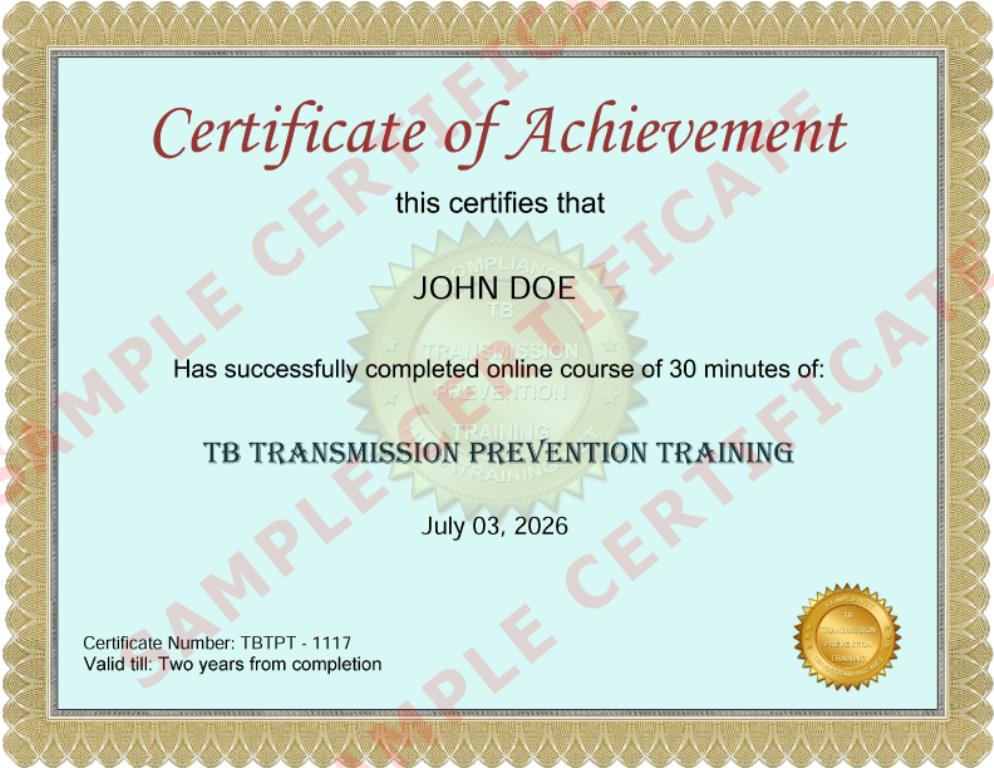
- Total Course Duration: 30 minutes
- Audio: Yes
- Number of Total Slides: 41 slides
- Online course login expires in: 2 months from receiving the login details. You will not have access to online content after you complete the course.
- Certificate valid for: 2 Years
- Type of License: One user license cannot be transferred after login is assigned.
Course Benefits
✔ Reduces occupational TB exposure risk
✔ Strengthens infection control programs
✔ Enhances regulatory compliance
✔ Protects staff, patients, and communities
✔ Supports safer clinical decision-making
Certificate of Completion
Participants receive a Certificate of Completion upon successfully finishing the course — suitable for regulatory documentation, personnel files, and compliance audits.