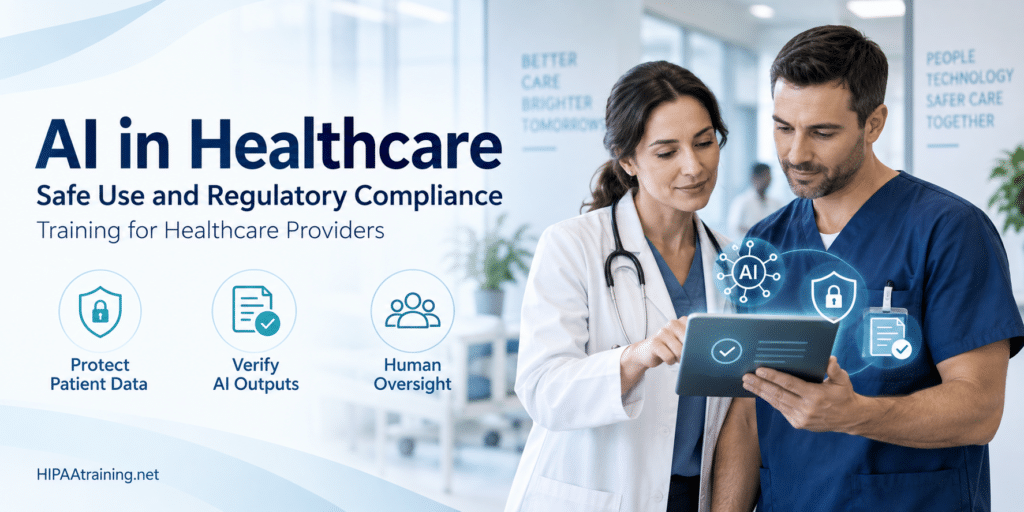
Learn to Use AI Safely While Protecting Patients and Health Information
Artificial intelligence is becoming part of healthcare operations. AI-assisted tools may support scheduling, intake, transcription, clinical documentation, patient messages, referrals, records, billing, and other daily tasks.
These tools can save time, but they can also produce inaccurate information, expose protected health information, or take actions without proper review.
This online AI in Healthcare Training helps healthcare providers and staff use approved AI tools more safely. Learners explore HIPAA privacy, AI security, output verification, patient safety, human oversight, fair treatment, and incident reporting.
Privacy, security, patient safety, accuracy, and reporting
Examples
Clinical, administrative, dental, pharmacy, laboratory, and patient-support workflows
Training level
Employee and healthcare workforce awareness
What Is AI in Healthcare Training?
AI in healthcare training teaches employees how to recognize and manage risks created by AI-assisted tools.
Artificial intelligence may generate useful drafts, summaries, predictions, or recommendations. However, AI can also:
Invent facts, appointments, instructions, or citations
Leave out important information
Change the meaning of clinical content
Mix information from different patients
Use outdated or incomplete source material
Request unnecessary access to healthcare systems
Produce errors that affect some patient groups more often
Send, save, or change information before proper review
This course teaches employees to treat AI-generated content as information that must be checked, not as a verified fact or final decision.
Five Rules for Safer AI Use in Healthcare
Employees should apply these five rules to every AI-assisted task:
Confirm the tool. Use only approved AI features and workplace accounts.
Protect patient information. Check what information may be entered, recorded, uploaded, or shared.
Review the output. Compare the result with the correct and current source.
Stay within your role. Keep clinical and professional decisions with authorized personnel.
Report problems. Promptly report unsafe results, unexpected actions, and possible information exposure.
Who Should Take This Course?
This healthcare AI training is designed for provider organizations and their workforce, including:
Physicians and healthcare providers
Nurses
Medical assistants
Dental professionals
Pharmacy employees
Laboratory personnel
Rehabilitation professionals
Home health employees
Patient-care coordinators
Reception and scheduling staff
Referral coordinators
Medical records personnel
Billing and coding employees
Patient-support teams
Privacy and security staff
Supervisors and department managers
The employer should determine which workers need AI training based on their responsibilities, access to patient information, and use of AI-enabled systems.
Why Healthcare Employees Need AI Training
Employees may encounter AI without opening a separate chatbot. AI features can be built into:
Electronic health record systems
Patient portals
Scheduling platforms
Dictation and transcription tools
Clinical documentation systems
Billing and coding applications
Referral systems
Email and office software
Meeting assistants
Translation tools
Browser extensions
A familiar screen or workplace email address does not mean an AI feature is approved. Employees need to know which tool, account, task, and information types are permitted.
What You Will Learn
After completing the course, learners should be able to:
Recognize common uses of AI in healthcare
Distinguish between AI drafting, prediction, and action
Confirm whether an AI tool and task are approved
Recognize protected health information in different formats
Protect prompts, recordings, files, images, and AI outputs
Recognize why removing a patient’s name may not de-identify information
Identify unsafe access requests and suspicious AI behavior
Create clearer prompts using approved information
Review outputs for errors, omissions, and changed meaning
Recognize automation bias
Maintain meaningful human oversight
Keep clinical decisions with qualified professionals
Identify repeated or potentially unfair AI errors
Communicate clearly with patients about AI-assisted processes
Report safety, privacy, and security concerns promptly
AI in Healthcare Course Modules
Module 1: AI in Everyday Provider Work
Learn how AI may appear in scheduling, intake, documentation, patient communication, referrals, records, and billing.
This module explains:
Basic AI and generative AI terms
Prompts and AI-generated outputs
Drafting versus taking action
Why confident language may still be wrong
How information moves through an AI workflow
Why human review remains necessary
Module 2: Choose Approved Tools and Uses
Employees learn to confirm four parts of approval:
The exact AI tool or feature
The designated workplace account
The intended task
The information permitted for that task
The course also explains why personal chatbots, browser extensions, paid subscriptions, and new software features should not be used for patient work unless they are specifically approved.
Yes. It is designed for healthcare provider organizations and their clinical, administrative, dental, pharmacy, laboratory, rehabilitation, home health, billing, records, and patient-support teams.
Yes. It explains how HIPAA privacy and security principles apply to AI prompts, uploads, recordings, outputs, storage, access, and information sharing.
Employees should use only the tools and accounts approved by their organization. A personal chatbot or subscription should not be used for patient work unless the organization has specifically authorized that use.
Yes. AI can produce missing, invented, outdated, or incorrect information. The proper reviewer should compare important content with the correct source before it affects a patient, record, message, bill, or care-related action.
AI may support an approved workflow, but clinical judgment remains with qualified healthcare professionals. An AI response or risk score does not independently establish a diagnosis or treatment plan.
Stop or hold the action when safe and authorized. Protect the patient and report the facts through the approved clinical, privacy, security, technical, or patient-safety process.
No. Compliance depends on the organization’s systems, policies, safeguards, contracts, risk assessments, employee duties, and applicable requirements.
Build Safer AI Practices Across Your Healthcare Workforce
Healthcare employees need practical guidance before AI-generated information affects a patient, medical record, message, bill, referral, or workplace decision.