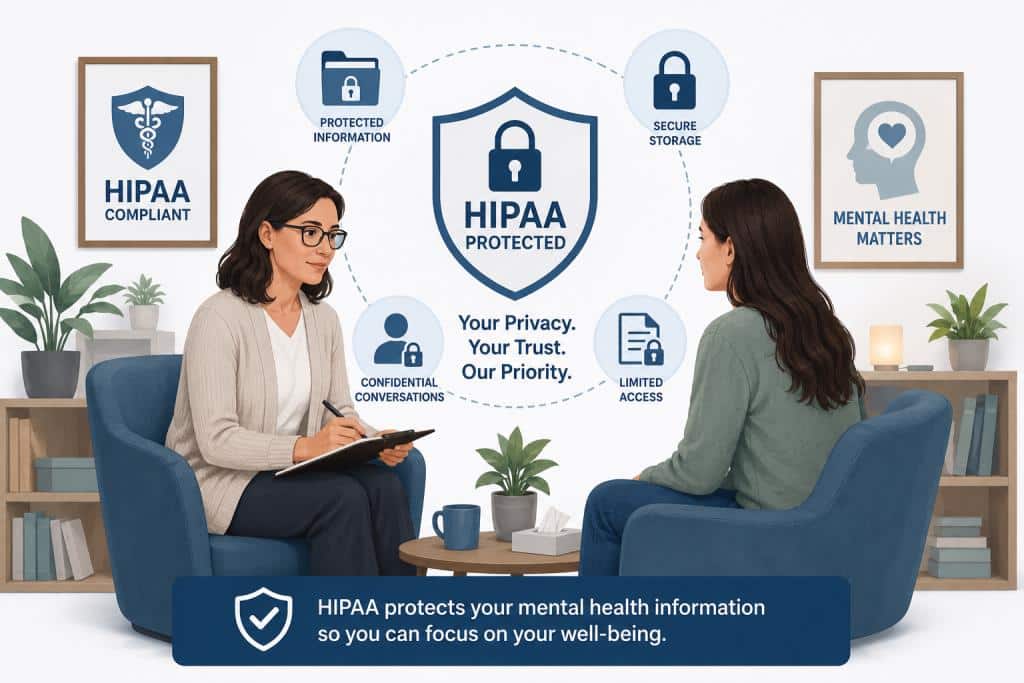
Mental health and behavioral health professionals handle some of the most sensitive protected health information (PHI) in healthcare. Therapy notes, psychiatric records, substance use disorder treatment information, telehealth communications, intake forms, patient portals, billing records, and digital tools all create important HIPAA privacy and security responsibilities.
This online, self-paced HIPAA awareness training course is designed for therapists, counselors, psychologists, psychiatrists, behavioral health staff, and other workforce members who access, use, store, disclose, or transmit protected health information. The training covers HIPAA Privacy and Security Rules, breach notification requirements, patient rights, psychotherapy notes, substance use disorder confidentiality, telehealth safeguards, cybersecurity awareness, and practical compliance best practices for modern mental health settings.
This course also highlights emerging compliance risks involving AI tools, digital health technologies, website tracking, remote access, 42 CFR Part 2 requirements, and evolving privacy expectations for behavioral health organizations.
Recommended For: Therapists, counselors, psychologists, psychiatrists, behavioral health professionals, addiction treatment staff, telehealth providers, and other healthcare workforce members who handle protected health information (PHI)
Online HIPAA Training for Mental Health & Behavioral Health Providers
Mental health and behavioral health organizations regularly handle highly sensitive protected health information (PHI), including treatment records, psychotherapy notes, medication details, crisis communications, referral information, insurance documentation, and substance use disorder treatment records.
This self-paced HIPAA awareness training is recommended for workforce members who require annual or ongoing HIPAA education and work in settings such as:
Psychology and psychiatry practices
Counseling and therapy offices
Addiction treatment and recovery programs
Behavioral health clinics
Community mental health centers
Telehealth therapy providers
Social work and case management practices
Marriage and family therapy practices
Psychiatric nursing programs
Art therapy and psychoanalysis practices
Religious counseling organizations
Other behavioral health and mental healthcare organizations
Who Should Take This Mental Health HIPAA Training Course?
This course is designed for workforce members who access, use, store, disclose, or manage protected health information in mental health or behavioral health settings. It is suitable for employees, contractors, trainees, volunteers, administrative personnel, clinical staff, supervisors, and managers who need HIPAA awareness training.
Recommended roles include:
Psychologists and psychiatrists
Therapists and psychotherapists
Licensed professional counselors and mental health counselors
Addiction counselors and behavioral health technicians
Clinical social workers and case managers
Marriage and family therapists
Psychiatric nurses and psychiatric support staff
Intake coordinators, billing teams, and front desk staff
Compliance officers, privacy officers, and security personnel
Practice managers and telehealth support staff
Other workforce members who may access protected health information (PHI)
Why HIPAA Training Matters for Mental Health Providers in 2026
Mental health and behavioral health professionals often handle highly sensitive patient information, including diagnoses, treatment histories, medications, crisis communications, substance use disorder records, and therapy-related discussions. Protecting this information is essential for maintaining patient trust, confidentiality, and HIPAA compliance.
In 2026, behavioral health organizations also face growing privacy and security risks related to:
AI tools used for documentation, transcription, scheduling, chat, and analytics
Telehealth platforms and remote work environments
Patient portals, online intake forms, and digital communication tools
Website tracking technologies and third-party analytics
Ransomware, phishing attacks, and credential theft
Mobile devices, cloud storage, and remote access systems
Improper disclosures to family members or unauthorized individuals
Confusion between psychotherapy notes, progress notes, and general treatment records
This course helps workforce members understand how HIPAA applies in real-world behavioral health settings and how to reduce the risk of improper disclosures, security incidents, compliance violations, and patient trust concerns.
2026 Update: Substance Use Disorder Records and 42 CFR Part 2
Updated for 2026, this course highlights key HIPAA and 42 CFR Part 2 considerations for mental health providers who handle substance use disorder treatment information. Staff learn when SUD records may require additional confidentiality protections, how consent and redisclosure rules can affect care coordination, and why approved workflows must be followed when sharing SUD information by email, text, portals, AI tools, or other digital platforms. The course also reinforces the need to review policies, notices, and workforce training for 2026 compliance.
2026 Update: Psychotherapy Notes & Mental Health Records
Updated for 2026, this course explains how HIPAA applies to psychotherapy notes and sensitive mental health records. Staff learn how psychotherapy notes differ from standard treatment records, why they require special handling, when patient authorization may be needed, and how to securely store, access, share, and protect therapy documentation. The training also reinforces that mental health records should only be accessed, copied, emailed, uploaded, or disclosed for authorized job-related purposes and in accordance with HIPAA requirements.
2026 Update: AI, Digital Tools, and HIPAA Privacy Risks
Updated for May 2026, this course highlights HIPAA privacy and security risks related to AI and digital tools used in mental health settings. Staff learn why PHI should not be entered into unapproved AI tools, chatbots, transcription apps, scheduling systems, or analytics platforms. The training also covers vendor and business associate concerns, risk analysis, role-based access, and the importance of verifying AI outputs before use. Workforce members are reminded to use only approved tools with proper safeguards in place.
What This HIPAA Course Covers
This course provides practical HIPAA awareness training for mental health and behavioral health professionals who handle protected health information (PHI) in clinical, administrative, telehealth, and digital healthcare environments.
Training topics include:
HIPAA Privacy Rule and Security Rule fundamentals
HITECH Act and breach notification awareness
Protected health information (PHI) and electronic protected health information (ePHI)
Patient identifiers and the minimum necessary standard
Permissible uses and disclosures of PHI
Treatment, payment, and healthcare operations (TPO)
Patient authorization and consent requirements
Psychotherapy notes and sensitive mental health records
Disclosures involving family members, caregivers, and personal representatives
Health and safety-related disclosures
Substance use disorder (SUD) confidentiality and 42 CFR Part 2 awareness
Notice of Privacy Practices (NPP) considerations
Business associates, vendor relationships, and third-party risks
Telehealth, remote work, and mobile device safeguards
AI tools, digital health technologies, and privacy risks
Website tracking technologies, patient portals, and online forms
Phishing, ransomware, cybersecurity, and social engineering awareness
Breach response, incident reporting, and documentation basics
Record retention, sanctions, and workforce responsibilities
Real-world examples and practical HIPAA scenarios for behavioral health settings
Privacy Rule, Security Rule, HITECH, Omnibus, and breach notification
Protected health information and electronic protected health information
Patient identifiers and health information sets
Covered entities, business associates, and workforce responsibilities
Privacy, security, and confidentiality objectives
HIPAA Privacy for Mental Health Providers
Uses and disclosures of PHI
Minimum necessary standard
Authorization versus consent
Patient rights under HIPAA
Notice of Privacy Practices awareness
Documentation and recordkeeping responsibilities
Permissible disclosures and patient options
Mental health information, family involvement, and care coordination
Health and safety disclosures
Psychotherapy Notes and Sensitive Mental Health Information
Difference between psychotherapy notes and progress notes
Special privacy protections for psychotherapy notes
Authorization requirements
Practical safeguards for therapy notes and clinical documentation
Common mistakes in mental health record handling
2026 SUD and 42 CFR Part 2 Awareness
Substance use disorder treatment record confidentiality
HIPAA and Part 2 relationship
2026 Part 2 update awareness
Patient consent and redisclosure considerations
SUD records in behavioral health workflows
Patient notices and privacy practice updates
Breach and complaint awareness for Part 2-related records
HIPAA Security and Cybersecurity Awareness
Administrative, physical, and technical safeguards
Security risk analysis and risk management awareness
Access controls and role-based access
Passwords, multi-factor authentication, and account security
Email, texting, mobile devices, and remote work
Phishing, ransomware, malware, and social engineering
Incident response and reporting suspected breaches
Audit logs and information system activity review
AI, Telehealth, and Digital Health Privacy
AI tools and PHI risks
AI documentation, transcription, chatbots, and analytics
Business associate considerations for digital vendors
Telehealth privacy safeguards
Patient portals, online forms, appointment scheduling, and tracking tools
Practical “do and don’t” examples for mental health staff
Breaches, Investigations, and Lessons Learned
Breach notification basics
Common mental health privacy incidents
Lost devices, misdirected emails, snooping, improper family disclosures, and unauthorized vendor access
Documentation, mitigation, and reporting
Real-world lessons for behavioral health practices
Review and Next Steps
Key HIPAA takeaways for mental health providers
Workforce responsibilities
Privacy and security best practices
Course review
Certification test
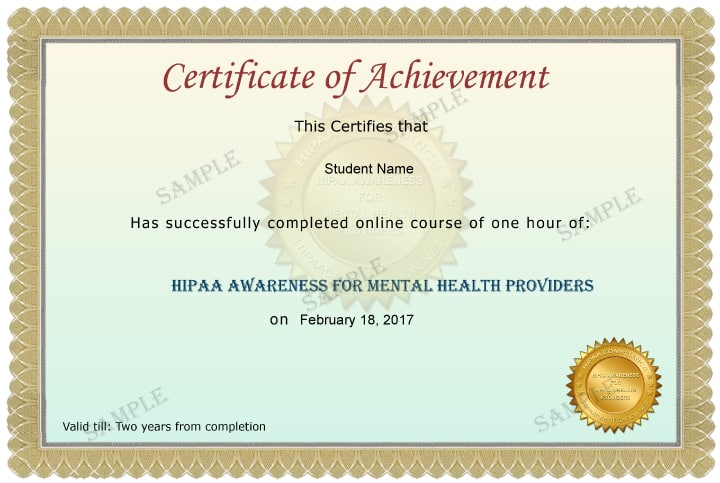
Certificate of Completion
Course Features
Online self-paced HIPAA awareness training
Designed for mental health and behavioral health providers
Updated May 2026 to highlight SUD, AI, digital health, telehealth, breach, and cybersecurity risks
Audio and slide-based format for easy learning
Practical examples for therapists, counselors, psychiatrists, psychologists, addiction counselors, clinical social workers, and support staff
Covers HIPAA Privacy, HIPAA Security, breach notification, psychotherapy notes, SUD privacy, and AI-related privacy risks
Certificate available after successful completion
24/7 online access during the access period
Suitable for individual employees and workforce training
Spanish version available
Compliance training bundle available for mental health providers
HIPAA Awareness Certification Test
After completing the training course, students must pass a multiple-choice assessment to earn their Mental Health HIPAA Awareness Training Certificate.
Test Format: Multiple-choice questions
Required Passing Score: 80%
Retakes: Students may retake the test until a passing score is achieved
Certificate Access: Certificates are available for immediate download or printing after successful completion
HIPAA Training for Mental Health Practices, Clinics, and Telehealth Providers
This HIPAA awareness training is designed for both individual mental health professionals and organizations that need workforce compliance education. The course is suitable for:
Private therapy and counseling practices
Group behavioral health organizations
Psychiatry and psychology practices
Addiction treatment and recovery programs
Community mental health clinics
Telehealth counseling and virtual care providers
Organizations serving patients with mental health or substance use disorder (SUD) needs
For organizations seeking broader workforce compliance education, the Mental Health Providers Compliance Training Bundle may be a better fit. The bundle combines HIPAA awareness training with additional compliance topics relevant to behavioral health, telehealth, privacy, security, and workplace operations.
[Explore Compliance Training Bundle for Mental Health Providers]
Why Choose This HIPAA Course?
Mental health and behavioral health professionals need HIPAA training that reflects real-world clinical and administrative workflows. This course focuses on practical privacy and security topics relevant to therapy, counseling, psychiatry, addiction treatment, intake processes, billing, telehealth, patient communication, and digital healthcare environments.
The training helps workforce members understand:
What qualifies as protected health information (PHI)
When patient information may be used or disclosed under HIPAA
How to protect psychotherapy notes and sensitive mental health records
Key differences between general PHI and substance use disorder (SUD) records
Privacy and security risks involving AI tools and digital health technologies
When vendors and third parties may be considered business associates
Common HIPAA mistakes involving email, texting, portals, and remote access
How to recognize and report potential privacy or security incidents
Why strong confidentiality practices are essential for maintaining patient trust
Training Courses For OSHA And Medicare
-Select Your Course Version-
GLOBALLY HARMONIZED SYSTEM (GHS) FOR HAZARD COMMUNICATION
Please contact us for more information at Bob@hipaatraining.net or call (515) 865-4591
Testimonials
Very informative, great way to learn about the details of HIPAA and how it relates to the mental health aspect.
Camerin Weaver
I thought the training was thorough and appreciated the learnings!
Sonali Sheel
Everything was great. I recommend this program for certification for HIPAA.
Yolande Glazier
Getting certified by HIPAA is daunting at first, but after a little bit of focus and review, the benefit of seeking education in these areas becomes more and more apparent. I appreciate the condensed materials offered in the lecture and the multiple attempts available to take the test, allowing space for myself to learn and digest the content.
Josey Hoffman
This was a very informative course
Kelsey P
I thought this was a good training
Marissa Benecke
Great course, easy to access and take test at convenience.
Laura M.
Information was helpful for my job as mental health professional
Michelle Bunk
This was a very intensive but extremely important course. I felt it’s gravity and importance. Good course.
Stella H.
The content was excellent. The language and communication of the presenter was great and I learned a lot. This training was helpful! Thank you
Joyce F.
Test was easy to understand and accommodating since you can retake the test as much as needed.
Jessica Milton
Very helpful & insightful. Will be using this information in the future.
Kennedy Pass
Very interesting course. The information was presented in an efficient manner with detailed explanations.
Yes. This course is appropriate for therapists, counselors, psychologists, psychiatrists, social workers, addiction counselors, behavioral health staff, and other workforce members who access mental health or substance use disorder information.
Yes. This course is updated in May 2026 to highlight current awareness topics for mental health providers, including SUD confidentiality, 42 CFR Part 2 updates, AI privacy risks, digital health tools, telehealth, breach notification, and Notice of Privacy Practices considerations.
Yes. The course includes awareness-level content on SUD treatment record confidentiality and why 42 CFR Part 2 may apply in addition to HIPAA for certain federally assisted substance use disorder programs and records.
Yes. The course helps staff understand the difference between psychotherapy notes, progress notes, and general mental health treatment records, and why psychotherapy notes require special handling under HIPAA.
Yes. A Spanish version is available through the registration option listed on this page.
Register for Mental Health Providers HIPAA Awareness Training
Protect patient privacy, support workforce compliance, and help your mental health or behavioral health organization stay current with HIPAA awareness training updated for the 2026 compliance environment.