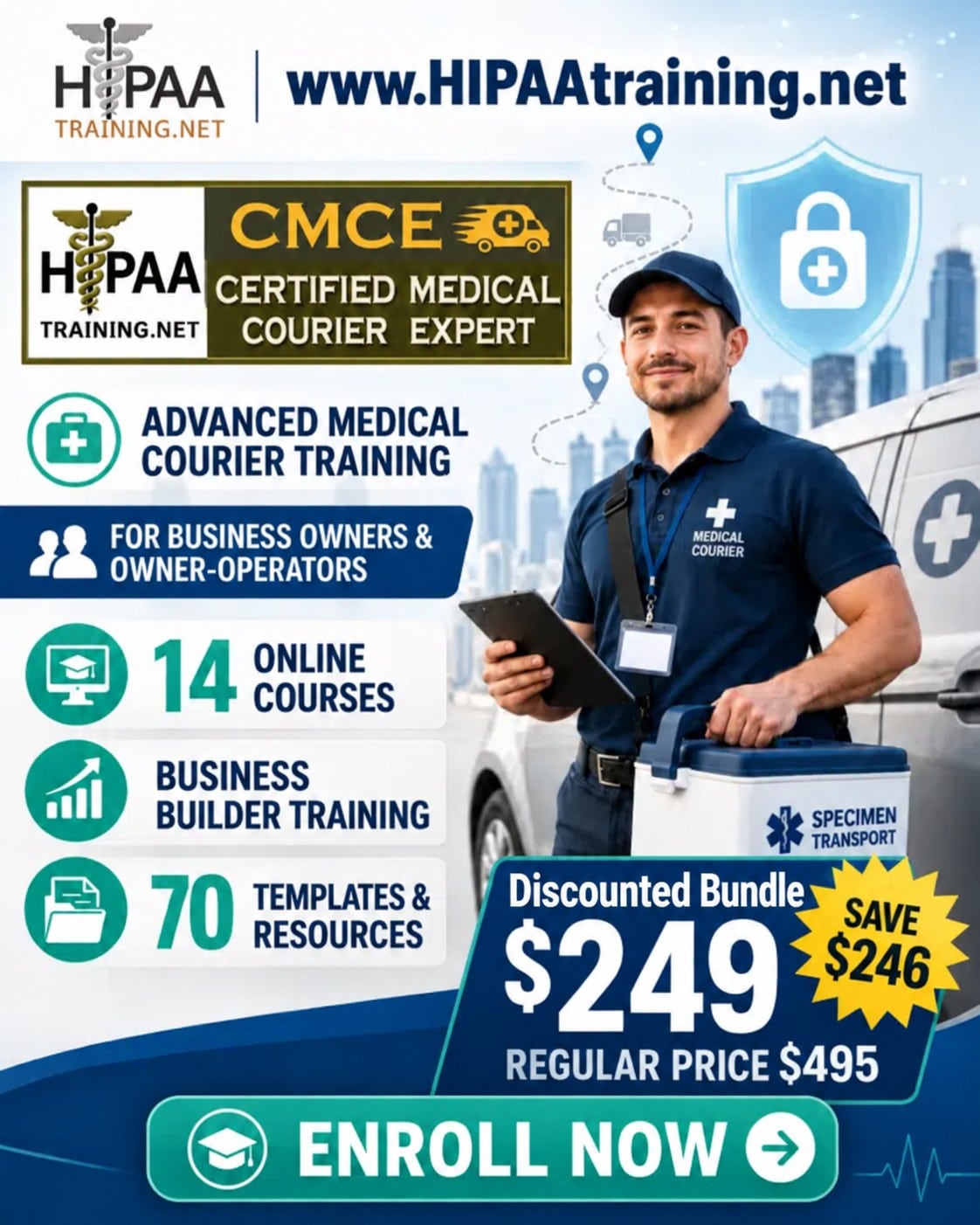
Advanced Medical Courier Training for Business Owners and Owner-Operators
Build the knowledge needed to operate and grow a professional medical courier business with the Certified Medical Courier Expert (CMCE) certification program.
CMCE is a comprehensive online training program that combines medical courier job-role training with medical courier business development and highway transportation training.
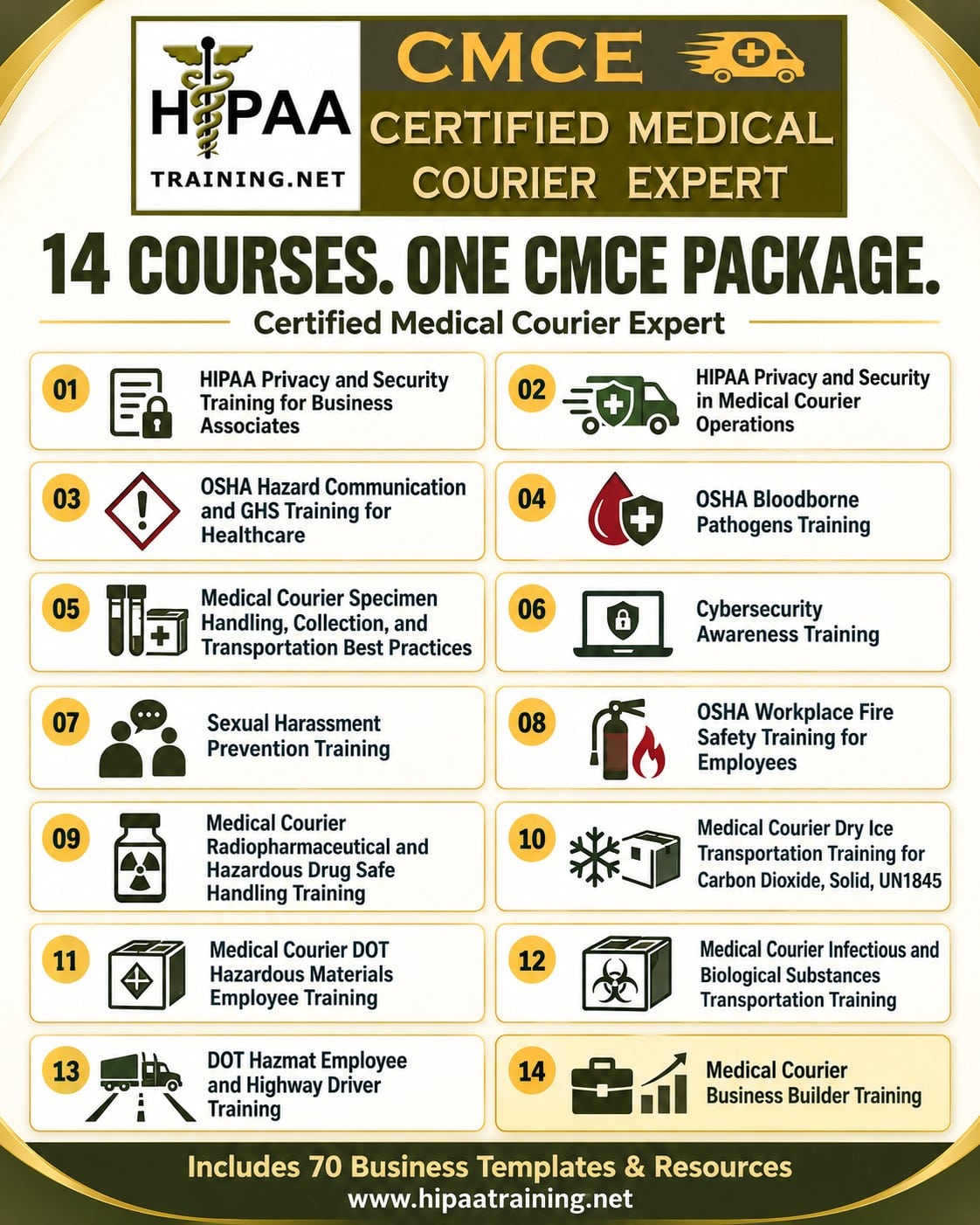
The program includes 14 online courses covering HIPAA privacy and security, OSHA safety, bloodborne pathogens, specimen transportation, UN3373, hazardous materials, dry ice, radiopharmaceuticals, cybersecurity, highway transportation, and medical courier business operations.
Medical courier business owners need more than driving and delivery skills.
They may need to understand healthcare privacy, workplace safety, specimen handling, transportation responsibilities, documentation, chain of custody, cybersecurity, client expectations, driver management, and business operations.
The CMCE certification brings these subjects together in one structured training program.
CMCE is designed for people who want to:
Start a medical courier business
Expand an existing courier operation
Work as a medical courier owner-operator
Manage medical courier drivers
Prepare for healthcare client discussions
Develop professional operating procedures
Understand medical delivery risks and responsibilities
Build repeatable business processes
Develop a stronger foundation for medical courier business growth
What Is the CMCE Certification?
CMCE stands for Certified Medical Courier Expert.
The CMCE certification is an advanced medical courier training program designed for business owners, aspiring entrepreneurs, owner-operators, independent contractors, managers, and professionals involved in healthcare delivery services.
CMCE combines the medical courier training covered in the Certified Medical Courier Professional (CMCP) program with additional business development and highway transportation training.
The curriculum addresses important subjects that may apply to medical courier operations, including:
HIPAA privacy and security
Bloodborne pathogen exposure
OSHA Hazard Communication and GHS
Medical specimen handling and transportation
Biological Substance, Category B, including UN3373
Dry ice transportation
DOT hazardous materials responsibilities
Radiopharmaceutical and hazardous drug handling
Cybersecurity awareness
Highway and vehicle safety
Medical courier business planning
Client development and contracting
The goal is to provide learners with knowledge covering both sides of medical courier operations:
Performing medical delivery services safely and professionally -and building the business systems needed to support those services.
Who Should Enroll in CMCE?
Aspiring Medical Courier Business Owners
Learn about the operational, safety, privacy, transportation, and business concepts involved in developing a medical courier company.
Current Medical Courier Business Owners
Strengthen your knowledge, improve business processes, and prepare for healthcare client expectations.
Medical Courier Owner-Operators
Build knowledge that supports both daily delivery responsibilities and business management.
Independent Medical Couriers
Develop a broader understanding of regulated deliveries, documentation, customer requirements, and business development.
Courier Managers and Supervisors
Understand important training and operational subjects involved in managing medical courier drivers.
Logistics and Transportation Entrepreneurs
Learn how medical courier services can differ from ordinary package, freight, and food delivery operations.
Healthcare Delivery Professionals
Expand your knowledge of healthcare privacy, safety, specimen handling, transportation, and client communication.
Complete 14-Course CMCE Curriculum
The CMCE certification bundle includes the following 14 online courses:
The Medical Courier Business Builder Training is a six-hour business development course included in the CMCE program.
It provides practical guidance for planning, launching, organizing, and developing a medical courier business.
Topics include:
Selecting a business structure
Business registration
Insurance considerations
Service planning
Defining a delivery territory
Establishing rates
Calculating operating costs
Identifying target clients
Contacting healthcare organizations
Preparing service proposals
Responding to contract opportunities
Hiring and managing drivers
Driver qualification
Training documentation
Standard operating procedures
Chain-of-custody processes
Incident reporting
Quality control
Client retention
Business growth planning
70 Medical Courier Business Templates and Resources
The Medical Courier Business Builder course includes 70 practical templates and resources that can help learners organize business planning and operating processes.
Resources may support areas such as:
Business planning
Client outreach
Service proposals
Pricing
Driver onboarding
Training records
Delivery documentation
Chain-of-custody procedures
Incident management
Quality assurance
Standard operating procedures
Operational checklists
Templates are designed as practical starting points and should be reviewed and adapted to the learner’s business, services, location, clients, and applicable requirements.
What You Will Learn
After completing the CMCE program, learners should be better prepared to:
Explain how medical courier operations differ from ordinary delivery services
Recognize common healthcare privacy and security risks
Protect sensitive healthcare information
Identify potential bloodborne pathogen exposure
Understand workplace chemical labels and Safety Data Sheets
Recognize important specimen handling considerations
Understand chain-of-custody documentation
Recognize specimen time and temperature requirements
Identify common hazardous material marks and labels
Understand the courier’s role in UN3373 transportation
Recognize major dry ice transportation hazards
Identify radioactive material transportation considerations
Recognize appropriate responses to leaks, damage, delays, and incidents
Protect mobile devices and electronic delivery information
Understand professional conduct expectations
Understand highway driver responsibilities
Plan and organize a medical courier business
Develop procedures for drivers and daily operations
Prepare for discussions with prospective healthcare clients
Why Medical Courier Business Owners Need Specialized Training
Medical courier companies may transport materials that are sensitive, time-critical, confidential, hazardous, or medically important.
Depending on the services offered, medical courier deliveries may include:
Patient specimens
Laboratory samples
Diagnostic materials
Biological Substance, Category B packages
Medications
Pharmacy deliveries
Medical records
Blood and blood products
Dental laboratory materials
Medical devices
Dry ice shipments
Hazardous drugs
Radiopharmaceuticals
Healthcare supplies
A missed delivery time, damaged package, documentation error, privacy incident, temperature deviation, or improper response to an incident can create problems for the courier company, its healthcare client, and the patient associated with the shipment.
CMCE provides structured training to help business owners develop a stronger understanding of these responsibilities before starting or expanding medical courier services.
If your primary goal is to develop your medical courier business knowledge in addition to learning medical courier operations, CMCE is the more comprehensive training option.
Potential Medical Courier Clients
Depending on your services, capabilities, insurance, equipment, and client requirements, medical courier businesses may provide services to organizations such as:
Medical laboratories
Diagnostic laboratories
Hospitals
Health systems
Physician offices
Urgent care centers
Dental practices
Dental laboratories
Pharmacies
Specialty pharmacies
Veterinary clinics
Blood banks
Plasma centers
Dialysis centers
Imaging centers
Oncology practices
Clinical research organizations
Pharmaceutical companies
Medical device companies
Home healthcare providers
Long-term care facilities
Assisted living communities
Public health departments
Government healthcare facilities
CMCE certification does not guarantee a contract or client relationship. Healthcare organizations establish their own vendor qualification, insurance, background screening, training, technology, and service requirements.
Medical Courier Services You May Prepare to Offer
The services a courier company can provide depend on its training, insurance, equipment, operating procedures, personnel, and client contracts.
Potential services may include:
Routine specimen delivery
Scheduled laboratory routes
STAT medical deliveries
Pharmacy deliveries
Medical record transportation
Dental laboratory deliveries
Healthcare supply delivery
Medical device delivery
Temperature-sensitive transportation
Dry ice shipment transportation
UN3373 package transportation
After-hours healthcare delivery
Interfacility delivery
Long-distance medical delivery
Dedicated route services
Some materials and services may require additional training, equipment, authorization, licenses, permits, insurance, or employer/client-specific procedures.
Why Choose the CMCE Training Bundle?
One Structured Program
CMCE brings medical courier operations, safety, privacy, transportation, and business subjects together in one organized training program.
Built for Medical Courier Operations
The curriculum applies healthcare privacy, safety, documentation, transportation, and security concepts to situations that medical couriers may encounter.
Driver and Business Owner Perspectives
CMCE addresses both delivery responsibilities and the business systems needed to manage medical courier operations.
70 Practical Business Resources
The Business Builder course includes 70 templates and resources that can help organize business planning, driver management, documentation, and operations.
Online Learning
Complete the courses online according to your schedule and the requirements of the program.
Advanced Professional Preparation
Use the knowledge gained from the program when developing procedures, preparing driver training, organizing operations, and communicating with prospective healthcare clients.
How the CMCE Certification Process Works
Step 1: Enroll in the Program
Enroll in the complete 14-course CMCE program through the Supremus Store checkout page.
Enter the learner’s correct:
Full legal or professional name
Email address
Login information is sent to the email address used during registration. The registered name may appear on course certificates and the CMCE credential.
The email includes the learner’s username, password, and training website information.
Learners should check spam or junk folders if the email does not appear in the inbox.
Step 3: Complete the 14-Course to earn CMCE
Complete all 14 courses and their respective test and download their individual certificates. The program is self-paced, but learners must complete the courses within the applicable access period.
Step 4: Request Your CMCP and CMCE Credential Certificates
After completing all 14 required courses and passing their assessments, request the CMCP and CMCE credential certificates included with your completed CMCE program.
Email Mike@hipaatraining.net with your full name, your training account email address, and confirmation that you have finished the CMCE program. Ask for your training record to be reviewed for the applicable credential certificates.
Our team will verify your course completion and provide instructions for accessing your certificates and using the official credential logos. Use each designation and logo after receiving confirmation that the corresponding credential has been awarded.
CMCE is designed for medical courier business owners, aspiring entrepreneurs, owner-operators, independent contractors, managers, supervisors, and individuals seeking advanced medical courier and business training.
CMCP includes 12 medical courier courses and is primarily intended for drivers and delivery professionals.
CMCE includes 14 courses and is designed for business owners, aspiring business owners, owner-operators, and managers. It adds Medical Courier Business Builder Training, 70 business resources, and highway driver training.
No. Purchasing the bundle does not by itself complete the certification requirements. The CMCE credential is earned after successfully completing all required courses and assessments.
No. Certification does not guarantee employment, clients, contracts, revenue, or business success. Healthcare organizations establish their own vendor qualification and contracting requirements.
No. Employers are responsible for evaluating the functions assigned to their employees and providing any additional workplace-specific, function-specific, equipment-specific, emergency, security, or recurrent training that applies.
No. CMCE is a training and certification program. It does not replace business registration, licenses, permits, transportation authority, insurance, driver licensing, vehicle requirements, or other federal, state, local, employer, or client-specific requirements.
Yes. Existing business owners may use the training to strengthen their knowledge and support the development of internal driver training and operating procedures. Each employer remains responsible for determining what additional training its workforce needs.
Start Building Your Medical Courier Business Knowledge
A successful medical courier operation requires more than reliable driving.
Medical courier professionals need to understand privacy, safety, specimen handling, documentation, transportation responsibilities, cybersecurity, client expectations, and business operations.
The Certified Medical Courier Expert (CMCE) program provides a structured path for learning about both medical courier operations and medical courier business development.
The Certified Medical Courier Expert program provides education and training on subjects relevant to medical courier operations and business development. It does not constitute legal advice and does not replace employer-specific training, function-specific training, recurrent training, business licenses, permits, insurance, transportation authority, client credentialing, or applicable federal, state, and local requirements.
Employers and business owners are responsible for evaluating their services, transported materials, employee duties, operating locations, and applicable requirements.
USER RATING:
The Certified Medical Courier Expert (CMCE) Certification Program is rated 4.9 out of 5 by 1503 learners.