
Make Your Training Visible. Strengthen Your Professional Image. Support Your Next Business Opportunity
Earning your medical courier certification is an important step. The next step is making sure employers, courier companies, and potential healthcare clients can understand what you earned and why it is relevant.
Do not leave your certification sitting in a download folder. Make it part of your professional introduction, online presence, and client proposal.
Your approach should connect three things:
The credential you earned, the services you can actually provide, and the documentation that supports your qualifications.
This guide explains how to display your CMCP and CMCE logos, describe your credentials accurately, and use them when pursuing jobs, contractor assignments, and direct client relationships.
Understand What You Are Showcasing
CMCP: Certified Medical Courier Professional
CMCP is a private professional training credential focused on medical courier responsibilities. It is designed for drivers, independent contractors, and healthcare delivery professionals. The program includes 12 courses, with the CMCP credential and logo-use rights available after successful completion of the requirements.
Use CMCP to highlight your investment in courier-specific training when applying for work or introducing your services.
CMCE: Certified Medical Courier Expert
CMCE includes the CMCP training foundation plus additional highway-driver and medical courier business training. The program includes 14 courses and is designed for owner-operators, business owners, managers, and professionals pursuing broader business responsibilities. After completion is verified, the program issues both CMCP and CMCE certificates.
Use CMCE to introduce both your professional training and your preparation for organizing and managing a courier business.
Display only credentials you have earned. Enrollment, payment, or partial course completion should not be presented as completed certification.
Use Your Credential Name Clearly
Always give people enough information to understand the letters.
On a resume, email signature, business card, or proposal, you can identify yourself using your earned designation:
[Your Name], CMCP
Certified Medical Courier Professional
[Your Name], CMCE
Certified Medical Courier Expert
After both credentials have been awarded:
[Your Name], CMCP, CMCE
Certified Medical Courier Professional
Certified Medical Courier Expert
The program pages provide examples of using credential letters after a graduate’s name and including them in professional materials. Follow the credential-use instructions supplied with your award.
For a short introduction, you can lead with CMCE and list both credentials in your detailed certification section. On a longer document, show both in full.
Avoid using only “certified courier” without naming the credential. Be specific about what was earned.
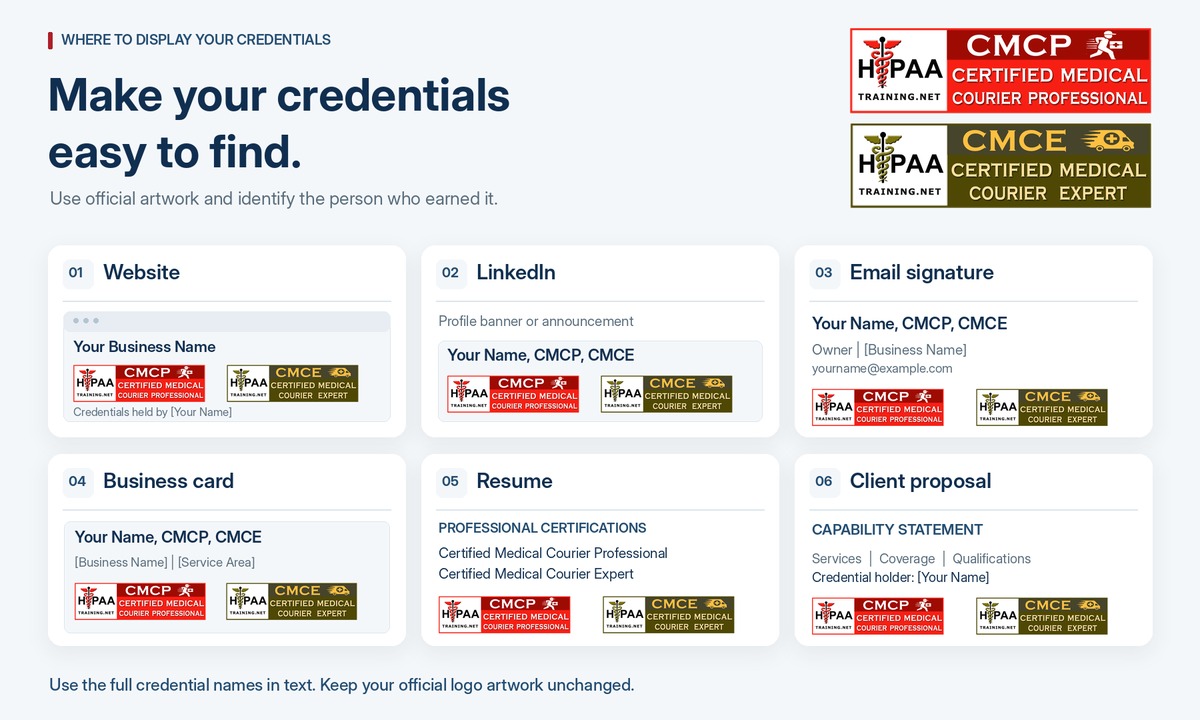
Where to Display Your CMCP and CMCE Logos
Start with the materials you use when applying, introducing yourself, or requesting a meeting.
The placements below are recommendations, subject to the issuer’s logo-use terms and any employer, client, or platform restrictions.
| Where to showcase it | Recommended placement | What to include with the logo |
|---|---|---|
| Business website | Near your introduction, owner biography, or qualifications section | Credential holder’s name, full credential title, and a link to credential details |
| LinkedIn profile | Certification entries, a professional announcement, or an appropriate banner | Full credential name, correct issuer, and actual issue date |
| Resume | A clearly labeled Certifications section | Credential title, issuer, completion date, and relevant training subjects |
| Email signature | Below your name, role, and contact information | Credential letters in text, with a small logo underneath |
| Business cards | CBelow your name or on the reverse side | Credential title, service area, and business contact information |
| Capability statement | In the professional qualifications section | Named credential holder, services, coverage, and supporting records |
| Client proposals | On the cover or in the qualifications section | A short explanation of how your training relates to the proposed work |
| Vendor applications | In the requested training or certification section | Actual certificates and accurate completion information |
| Brochures and presentations | Near the owner introduction or service qualifications | A readable explanation rather than an unexplained badge |
| Uniforms or vehicle graphics | Only where permitted and appropriate | Clear identification of the credential holder without implying company-wide certification |
Do not try to place a logo everywhere at once. First update the materials a potential client is most likely to review before contacting you.
Add Your Credentials to Your Business Website
Put the Credential Near a Useful Message
Place your credential near information about what you do, where you operate, and how someone can contact you.
A logo at the bottom of a page gives little context. A logo beside a named professional, a service description, and a clear next step creates a more complete introduction.
Example for a CMCP-certified independent courier:
Medical Courier Services in [Service Area]
I’m [Your Name], a Certified Medical Courier Professional providing [services you currently offer].
My professional training supports my focus on careful handling, clear communication, and following client delivery instructions.
Contact me to discuss your route requirements and review my qualifications.
Example for a CMCE-certified business owner:
Medical Courier Services Led by a CMCE-Certified Owner
[Business Name] serves [Service Area] and is owned by [Your Name], who holds the Certified Medical Courier Professional and Certified Medical Courier Expert credentials.
Contact us to discuss [services currently offered], review our qualifications, and determine whether our coverage fits your needs.
Use these examples only when they match your actual credentials, business structure, and services.
Create a Dedicated Credentials Section
A page titled Professional Credentials and Training can bring your qualifications together.
Include your name, role, full credential titles, issuing organization, and actual award dates. Add a short training summary and explain how a prospective employer or client can request supporting documents.
Keep your business’s operational capabilities separate from your training record. For example, a course covering temperature-sensitive shipments should not be presented as proof that your business already has the equipment and procedures for every temperature-controlled delivery.
Make the Next Step Clear
Place a relevant action beside the credential section:
Request Our Capability Statement
Discuss Route Coverage
Request a Courier Service Quote
For someone seeking employment, a better action may be:
View My Resume or Contact Me About Courier Opportunities
Distinguish Information From Verification
A link to a general certification program page explains the program. It does not verify that a particular person earned the credential.
Use labels such as About This Certification for program information.
Use View My Credential Details for your own documented credential information. Describe a link as official verification only when the issuer actually provides that function.
Showcase Your Credentials on LinkedIn
Complete Your Certification Entries
Add the full certification title and use the issuing organization shown on your award documents. Include the actual issue date and enter a credential ID or public credential URL only when one has been supplied.
Do not invent a certificate number, claim a renewal status you have not confirmed, or link to your private learner account.
LinkedIn supports adding professional certifications to a profile and provides an Add to Profile feature for certification providers.
When you hold both credentials, use separate entries for:
Certified Medical Courier Professional (CMCP)
Certified Medical Courier Expert (CMCE)
Write a Headline That Explains Your Role
For a driver or independent contractor:
Certified Medical Courier Professional | Seeking Courier Opportunities in [Service Area]
For a business owner:
Medical Courier Business Owner | CMCP and CMCE | Serving [Service Area]
For an established owner-operator:
Owner-Operator at [Business Name] | Certified Medical Courier Expert | [Services Actually Offered]
Choose wording that reflects your current position. Someone preparing to launch a business should not imply that the operation is already established.
Use a Professional Announcement
Sample post after both credentials have been awarded:
I’m pleased to share that I have earned the Certified Medical Courier Professional and Certified Medical Courier Expert credentials.
This training is part of my preparation for [your next professional goal].
I am interested in connecting with [relevant employers, courier companies, or healthcare organizations] in [Service Area].
My next step is to discuss service needs, review onboarding requirements, and identify opportunities that match my qualifications.
Add the official logo artwork where permitted. Keep the message focused on your next professional step rather than making unsupported claims about experience or business success.
Logo display note: LinkedIn’s certification display uses the logo associated with the selected organization’s LinkedIn Page. Adding a certification does not necessarily display your individual CMCP or CMCE badge.
Update Your Resume, Email Signature, and Business Cards
Resume Example
Keep the credential information in text, even when you also include a logo.
PROFESSIONAL CERTIFICATIONS
Certified Medical Courier Professional (CMCP)
[Issuing Organization] | Awarded [Month Year]
Certified Medical Courier Expert (CMCE)
[Issuing Organization] | Awarded [Month Year]
Relevant training: [Select subjects you completed that relate to the position.]
Separate training from work experience. A certification entry should describe education you completed, not suggest years of delivery experience you do not have.
For an online job application, follow the employer’s formatting instructions. Do not make a logo the only place where your credential appears.
Email Signature Example
[Your Name], CMCP, CMCE
Owner | [Business Name]
Certified Medical Courier Professional
Certified Medical Courier Expert
[Business Phone] | [Business Email]
[Website]
Serving [Service Area]
[Official CMCP Logo] [Official CMCE Logo]
Use a smaller version of the appropriate logo beneath the text. Your name and contact information should remain readable without the images.
Business Card Example
[Your Name], CMCP, CMCE
Owner, [Business Name]
Medical Courier Services
Serving [Service Area]
[Phone] | [Email] | [Website]
[Official Credential Logos]
A QR code can lead to your website or capability statement. Label its destination clearly, such as View Services and Credentials, and test it before printing.
Build a Client-Ready Capability Statement
A capability statement is a short introduction to your business and its qualifications. Consider starting with one page that a prospective client can review and share.
Your logo should support the document, not replace the information someone needs to evaluate your services.
Suggested Capability Statement Content
Business overview: State who you are, what your business provides, and where you operate.
Services and availability: Identify your actual delivery services, operating hours, coverage, and capacity.
Professional qualifications: Name the person who holds CMCP, CMCE, or both.
Operating approach: Summarize the procedures you actually use for delivery documentation, communication, package concerns, and escalation.
Supporting documents: Explain which training records, insurance documents, references, and other onboarding materials are available.
Contact and next step: Invite the reader to discuss a route, request a quote, or explain their vendor requirements.
Sample Qualifications Paragraph
[Business Name] is owned by [Your Name], who holds the Certified Medical Courier Professional and Certified Medical Courier Expert credentials.
Supporting credential documents are available for review. Before accepting an assignment, we review the requested services, delivery instructions, operating requirements, and our ability to perform the work.
Keep the distinction clear: a named owner’s credential is not the same as an independently certified company or an entirely certified workforce. Advertising should accurately describe who holds the qualification and what it supports.
Make Your Client Proposals Specific
Do not submit a proposal that relies on “We are certified” as the main reason to select you.
Connect your qualifications to the assignment, then explain how you would perform it.
For a Laboratory Proposal
Consider addressing pickup windows, package acceptance procedures, delivery documentation, temperature instructions, and how concerns would be reported.
Pair your relevant training record with a description of the procedures and equipment your business actually uses.
For a Pharmacy Proposal
Consider addressing recipient instructions, unsuccessful delivery procedures, secure handoffs, communication, and any handling requirements identified by the client.
Do not advertise specialized delivery capabilities based only on a course title.
For a Courier Company Seeking Subcontractors
Focus on your service area, available hours, vehicle suitability, training documents, communication, and willingness to complete the company’s onboarding process.
For a Direct Healthcare Client
Explain who would manage the account, who would perform the deliveries, how coverage would be arranged, and how service concerns would be handled.
A useful proposal pattern is:
Client need: [The delivery problem or requirement discussed.]
Relevant qualification: [Your earned credential and relevant training.]
Proposed approach: [The procedures, coverage, and resources you can provide.]
Supporting evidence: [Documents, references, or records available for review.]
Next step: [A requirements meeting, onboarding review, or written quote.]
Use your credential as supporting evidence within a complete service proposal, not as a substitute for one.
Use Your Credentials in Client Outreach
Lead with relevance. Introduce the service area or delivery need you can address, identify your qualifications, and ask for a manageable next step.
Sample Business Introduction Email
Subject: Medical courier coverage for [Organization] in [Service Area]
Hello [Name],
I’m [Your Name], owner of [Business Name]. I hold the Certified Medical Courier Professional and Certified Medical Courier Expert credentials.
We provide [services currently offered] in [Service Area], and I am reaching out to ask about your process for reviewing courier providers.
I would welcome a brief conversation about your delivery needs, vendor requirements, and any coverage gaps we may be able to support.
My capability statement and supporting credential documents are available for review.
Are you the appropriate contact for courier services, or should I speak with someone else?
Thank you,
[Your Name], CMCP, CMCE
[Business Name]
[Business Phone] | [Business Email]
[Website]
Advertisement for [Business Name] courier services.
[Valid Business Postal Address]
To stop receiving marketing emails from us, reply “unsubscribe.”
For commercial email, use accurate sender information and subject lines, provide the required advertising identification and postal address, and offer a working opt-out method. CAN-SPAM also applies to business-to-business marketing email. Honor opt-out requests within the required period.
Follow Up With Something Useful
Rather than repeatedly asking whether someone saw your message, offer a relevant detail:
I’m following up on my introduction about courier coverage in [Service Area]. We currently have [accurate availability or capacity].
I can provide our capability statement for your review and would appreciate learning about your vendor application process.
Keep any required marketing footer in the follow-up. Stop marketing contact when someone opts out.
Prepare for the First Conversation
Before a meeting, identify what you need to learn about the proposed work.
Ask about the materials involved, pickup and delivery windows, service area, documentation, communication expectations, onboarding, and backup coverage requirements.
Then explain where your qualifications and operating capabilities fit. Be equally clear about services you are not yet prepared to offer.
Support Your Logos With Real Evidence
A useful presentation includes more than a badge.
Prepare Two Versions of Your Professional Packet
Public introduction: Include your business overview, service area, professional biography, earned credentials, and contact information.
Private onboarding packet: Keep detailed certificates and any requested insurance, screening, licensing, or other sensitive records ready for secure sharing with the appropriate recipient.
Do not publish a full onboarding folder just to make your qualifications visible. Keep account passwords, driver’s license numbers, tax documents, and other sensitive information out of public marketing materials.
For sample delivery forms or presentations, use fictional records. Avoid real patient names, package labels, delivery addresses, or other private information.
Use Actual Performance Records
As your business gains experience, consider supporting proposals with documented results.
Examples include pickup and delivery performance for a defined period, response times, completed assignments, or client feedback you have permission to use.
Do not invent numbers or present a small sample as proof of company-wide performance.
Testimonials must reflect genuine experience and should not make claims that lack support. Any material connection that affects how an endorsement would be understood should be disclosed.
Keep Your Logo Presentation Clean and Accurate
Request the official artwork and current usage instructions from the certification provider. The design suggestions below do not expand the permission attached to the logos.
Preserve the Official Design
Use the supplied artwork rather than recreating the badge. Keep its proportions, wording, and colors intact unless an approved alternative is provided.
Avoid stretching, cropping, adding effects, or combining the credential logo into a new business logo.
For printing, request suitable artwork before ordering cards, signs, or clothing.
Keep the Credential Holder Identifiable
Place the logo near the name or biography of the person who earned it.
Use wording such as:
Owner: [Your Name], CMCE
Or:
Professional credentials held by [Your Name]: CMCP and CMCE
Avoid an unexplained badge beside the company name when it could suggest that the credential applies to every employee or the entire organization.
Use Text Alongside the Image
Write the full credential name near the logo. On a website, add descriptive alternative text, such as:
Certified Medical Courier Professional credential held by [Name]
Test the presentation on a phone and in print. Reduce clutter rather than shrinking the logo until its wording becomes unreadable.
Be Careful With Uniforms and Vehicles
Before using the logos on clothing or vehicle graphics, confirm the permitted use and any relevant employer or client restrictions.
Consider security and confidentiality before advertising that a vehicle performs medical deliveries. Never use a credential badge in place of required shipment markings or identification.
Avoid Claims That Your Credential Does Not Support
Describe your training accurately. Do not turn a professional credential into a claim of government approval or guaranteed business performance.
Avoid statements such as “government-certified medical courier,” “approved for every healthcare shipment,” or “guaranteed to meet every client requirement” unless you have separate, valid support for the exact claim. Advertising claims must be truthful and evidence-based.
Do not use a training certificate as proof that an entire operation is HIPAA compliant. HHS does not endorse or recognize private organizations’ Security Rule certifications as a replacement for legal obligations.
Likewise, do not treat a logo as a substitute for applicable transportation training. PHMSA assigns hazmat employers responsibilities for training, testing, certification, and records, including function-specific and recurrent training requirements.
Present your credential as evidence of completed professional training. Present your business capabilities through the procedures, equipment, records, and qualifications that support them.
Put Your Credentials to Work: A 30-Day Plan
Week 1: Organize Your Qualifications
Confirm that your credentials have been issued. Obtain the official logos and usage instructions, check your award details, and organize your certificates.
Update your resume and email signature.
Week 2: Improve Your Public Introduction
Add your credentials to LinkedIn and your website. Prepare a one-page capability statement and check that all names, dates, service descriptions, and contact details are consistent.
Week 3: Start Relevant Conversations
Identify organizations within your actual service area and capacity. Prepare a focused introduction for each type of prospect.
Ask about their courier needs and vendor process rather than sending the same broad claim to everyone.
Week 4: Review and Improve
Track replies, meetings, document requests, quotes, and next steps. Note which questions prospects ask most often.
Use that feedback to improve your website and capability statement. Evaluate meaningful business conversations, not just profile views or logo clicks.
Frequently Asked Questions
Should I show both CMCP and CMCE?
After both credentials have been awarded, you can identify both in your professional materials, subject to the issuer’s usage instructions. For a compact layout, lead with one credential and list the complete record in your qualifications section.
Do I need to publish every course certificate?
A practical approach is to feature your main credentials publicly and keep the individual course certificates organized for review. Provide the records relevant to a particular employer or client request.
Can I call every driver in my company certified?
Only describe a driver as holding CMCP or CMCE when that individual has earned the credential. Keep your wording specific and your personnel records current.
What should I do when a certificate or training requirement has a renewal date?
Follow the award documents, issuer instructions, and any separate employer or regulatory requirements. Do not assume that every course certificate and professional credential follows the same schedule.
Will displaying my certification guarantee new business?
No. Use the credential to support your introduction and make your qualifications easier to review. Winning work also requires a suitable service offering, client acceptance, operational readiness, and dependable performance. The programs do not guarantee employment or contracts.
Turn Your Certification Into a Professional Introduction
Make your qualifications visible, explain them clearly, and connect them to the work you are prepared to perform.
Show the credential. Name the person who earned it. Explain the relevant service. Provide supporting evidence. Offer a clear next step.
Already certified? Start with your website, email signature, LinkedIn profile, and capability statement.
Preparing to earn your credential? Explore the CMCP and CMCE programs and choose the path that fits your professional goals.