
A healthcare gas cylinder must stay identified, protected, and secure throughout a delivery. If it shifts inside a vehicle or its valve is damaged, a routine trip can become a safety incident.
HIPAA Training offers this online course for drivers and healthcare transport staff who handle sealed, non-bulk compressed gas cylinders by highway. It focuses on the courier’s work: checking a prepared cylinder, moving it with approved equipment, securing it in the vehicle, and completing an authorized handoff.
Price: $25
Format: Online, self-paced
Course length: 40 Minutes
Assessment: 10 questions; 80% passing score
Certificate: Downloadable PDF course completion certificate
Designed for: Medical couriers and personnel assigned to transport prepared healthcare gas cylinders
Course Access: 2 months or course completion, whichever comes first. No access after course is completed.
What is compressed gas transportation training?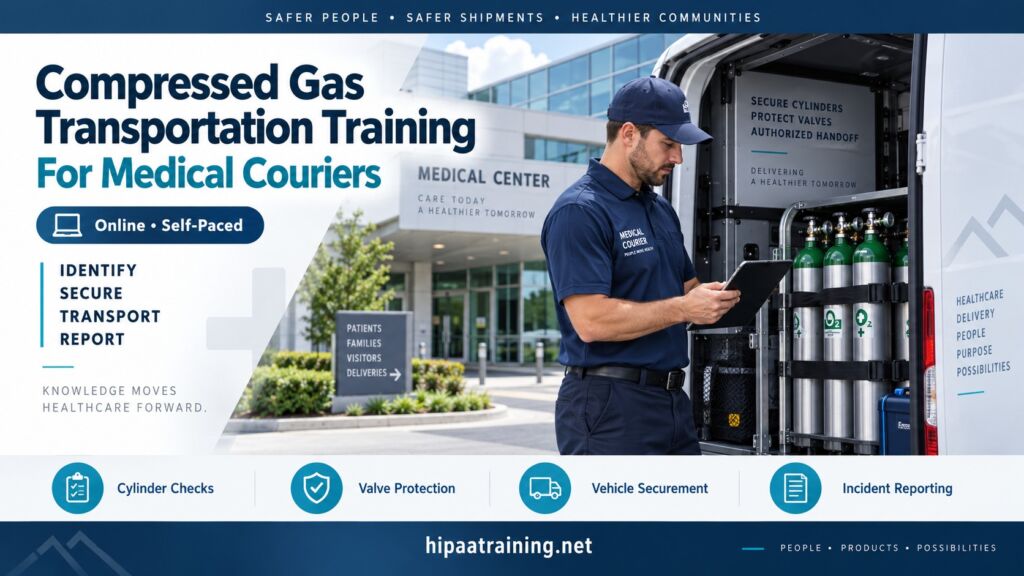
This course teaches the handling and transportation decisions a driver makes with prepared healthcare gas cylinders. Learners review cylinder identification, visible condition, valve protection, handling equipment, vehicle securement, delivery, returns, and incident reporting.
The course addresses examples such as compressed oxygen, nitrous oxide, carbon dioxide, nitrogen, helium, argon, and compressed air. Drivers should confirm the gas using cylinder markings and shipment information, not cylinder color alone.
What will you learn?
After completing the course, you should be able to:
- Match a cylinder to the assigned gas and delivery
- Recognize visible cylinder, valve, or protective-device damage
- Explain why cylinders must be restrained during transport
- Use employer-approved carts, racks, and securement methods
- Keep required shipment information available
- Protect cylinders from impact, heat, and unauthorized access
- Handle returned cylinders under company procedures
- Recognize a possible leak and report an unsafe condition
- Confirm the recipient before completing a delivery
Why is vehicle securement important?
A cylinder can move when a vehicle turns, brakes, or is involved in a collision. Movement can damage the cylinder or valve and create a gas-release hazard.
Drivers must use the approved rack, restraint, or packaging for the cylinders they carry. Check the load before departure and after any pickup or delivery that changes it. Full, partly used, and returned cylinders all need appropriate securement.
What should a driver check before loading?
Follow your employer’s acceptance procedure. Before loading, confirm that:
- The cylinder matches the delivery assignment
- Its markings and shipment information are consistent
- The cylinder and valve appear intact
- Required valve protection is in place
- There is no sign of a leak
- Approved handling and securement equipment is available
If the gas identity is unclear, a cylinder appears damaged, or the load cannot be secured, stop and contact the designated supervisor. Do not repair a valve or improvise a restraint.
Who should take this course?
This course is intended for medical oxygen delivery personnel, medical couriers, vehicle loaders, independent contractors, and supervisors whose duties affect the transport of prepared healthcare gas cylinders.
Employers should add instruction for the specific gases, cylinder sizes, vehicles, handling equipment, routes, and procedures used in their operations.
Frequently Asked Questions
USER RATING:
Medical Courier Compressed Gas Transportation Training is rated 4.9 out of 5 by 2621 users.