
12 Online Courses for Medical Courier Drivers

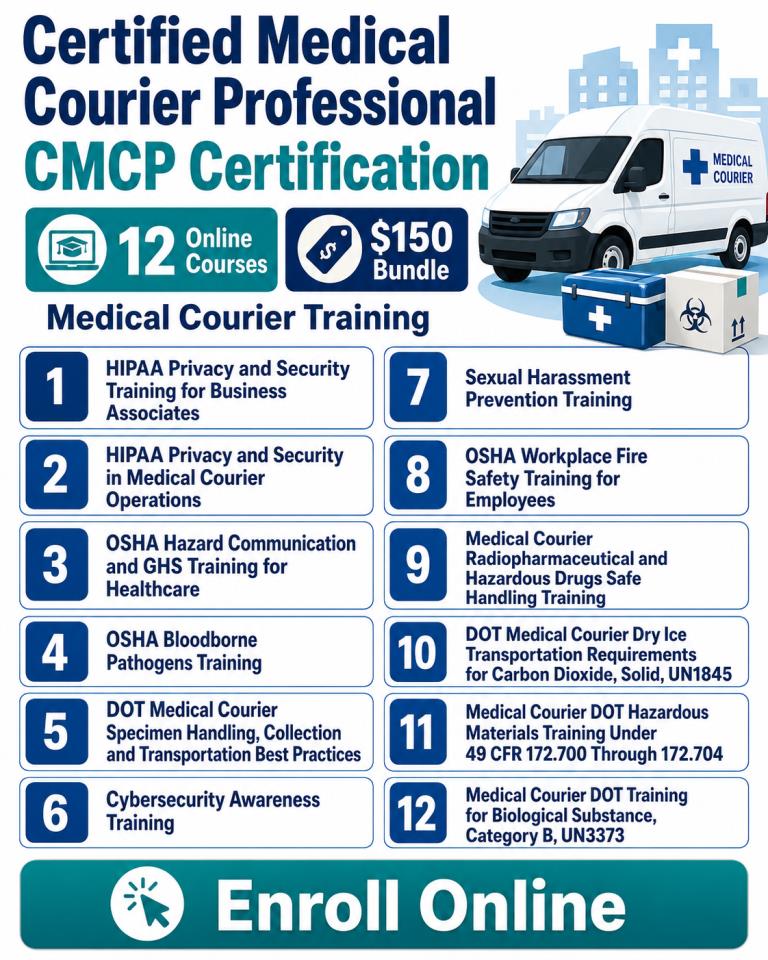
The CMCP certification program combines 12 self-paced online courses covering medical courier responsibilities related to HIPAA, OSHA safety, specimen transportation, cybersecurity, hazardous materials awareness, dry ice, UN3373, hazardous drugs, radiopharmaceutical shipments, workplace conduct, and fire safety.
CMCP at a Glance
- 12 online courses
- Self-paced training
- Medical courier-focused curriculum
- Current bundle price: $150
- Online assessments
- Course completion certificates
- CMCP credential upon meeting program requirements
Secure checkout is completed through the SupremusStore.com shopping cart.
What Is CMCP Certification?

The Certified Medical Courier Professional (CMCP) program is designed to help medical couriers understand the responsibilities involved in transporting sensitive healthcare materials and information.
Medical courier work involves more than driving from one location to another. Depending on the assignment, couriers may need to protect patient information, secure packages, follow temperature instructions, maintain chain-of-custody procedures, recognize hazards, document deliveries, and report problems.
CMCP brings these topics together in one structured medical courier certification program.
The program is intended for new and experienced medical couriers, independent contractors, healthcare delivery drivers, laboratory couriers, pharmacy delivery personnel, and courier company employees.
CMCP is a private professional training credential. It is not a federal or state medical courier license.
What Does a Medical Courier Need to Know?
Medical couriers may encounter sensitive information, diagnostic specimens, pharmaceuticals, dry ice shipments, hazardous materials, and other healthcare-related deliveries.
CMCP training helps learners understand how to:
- Protect patient and client information
- Follow secure pickup and delivery procedures
- Maintain chain-of-custody documentation
- Protect specimen integrity during transportation
- Recognize common workplace and transportation hazards
- Inspect prepared packages before acceptance
- Secure packages inside a vehicle
- Recognize UN3373 Biological Substance, Category B shipments
- Understand common dry ice transportation hazards
- Protect mobile devices and courier applications
- Respond appropriately to spills, leaks, accidents, and exposures
- Recognize suspicious or unauthorized delivery requests
- Document and report incidents
- Know when to stop and contact a supervisor
Inspect. Protect. Secure. Document. Report.
12 Courses Included in the CMCP Certification
The current CMCP shopping cart includes these 12 online courses:
1. HIPAA Privacy and Security Training for Business Associates
Introduces HIPAA privacy and security concepts that may apply when a courier organization performs services involving protected health information on behalf of a healthcare organization.
Topics include:
- Protected health information (PHI)
- Covered entities and business associates
- Privacy and security safeguards
- Permitted uses and disclosures
- Business associate agreements
- Incident and breach reporting
- Workforce responsibilities
Whether a courier organization is a HIPAA business associate depends on the services performed and its relationship with the healthcare client. Certain couriers may qualify as conduits under HIPAA.
2. HIPAA Privacy and Security in Medical Courier Operations
Focuses on practical privacy situations medical couriers may encounter during daily routes.
Topics include:
- Patient information on labels and documents
- Route manifests and pickup instructions
- Electronic proof of delivery
- Mobile phones and courier applications
- Package photographs
- Conversations at pickup locations
- Vehicle and package security
- Misdeliveries and lost packages
- Reporting suspected privacy incidents
3. OSHA Hazard Communication and GHS Training for Healthcare
Teaches workers how to recognize and respond to chemical hazards that may be present in healthcare, laboratory, pharmacy, and courier environments.
Topics include:
- Hazard communication labels
- GHS pictograms
- Safety Data Sheets (SDS)
- Signal words and hazard statements
- Chemical exposure routes
- Personal protective equipment
- Spill and leak reporting
OSHA’s Hazard Communication Standard applies when employees may be exposed to hazardous chemicals in the workplace. Employer-specific training and procedures may also apply.
4. OSHA Bloodborne Pathogens Training
Introduces the risks associated with occupational exposure to blood and other potentially infectious materials.
Topics include:
- Bloodborne pathogen transmission
- Exposure risks
- Universal and standard precautions
- Personal protective equipment
- Contaminated packages
- Sharps injury prevention
- Exposure reporting
- Post-exposure procedures
OSHA’s Bloodborne Pathogens Standard applies to employees with reasonably anticipated occupational exposure to blood or other potentially infectious materials. Employer-specific exposure control procedures remain applicable.
5. DOT Medical Courier Specimen Handling, Collection and Transportation Best Practices
Covers medical courier practices that can affect specimen condition and delivery.
Topics include:
- Package inspection
- Primary, secondary, and outer packaging
- Temperature requirements
- Refrigerated and frozen shipments
- Chain of custody
- Secure vehicle placement
- Delivery delays
- Rejected specimens
- Authorized handoff
- Incident documentation
This course does not authorize a courier to perform clinical specimen collection unless the courier has separately received the required training and authorization.
6. Cybersecurity Awareness Training
Helps medical couriers protect patient information, client information, credentials, and route data while using digital tools.
Topics include:
- Phishing
- Password security
- Multifactor authentication
- Mobile device security
- Courier applications
- Public Wi-Fi
- QR code and link scams
- Lost or stolen devices
- Security incident reporting
7. Sexual Harassment Prevention Training
Provides workplace training focused on respectful and professional conduct.
Topics include:
- Prohibited workplace conduct
- Verbal, visual, and physical harassment
- Harassment involving clients or vendors
- Reporting procedures
- Retaliation protections
- Bystander awareness
- Professional communication
Additional state, local, employer, or client-specific requirements may apply.
8. OSHA Workplace Fire Safety Training for Employees
Introduces workplace fire prevention and emergency response.
Topics include:
- Common fire hazards
- Electrical and battery risks
- Flammable materials
- Fire prevention
- Emergency exits
- Alarm and evacuation procedures
- Fire extinguisher awareness
- Vehicle-related fire concerns
The course emphasizes that protecting people takes priority over protecting a package or vehicle.
9. Medical Courier Radiopharmaceutical and Hazardous Drugs Safe Handling Training
Introduces risks associated with prepared shipments containing hazardous drugs or radiopharmaceutical products.
Topics include:
- Hazardous drug transportation risks
- Radiation warning symbols
- Radioactive material labels
- Transport Index information
- Secondary containment
- Shipping documents
- Vehicle loading
- Temperature requirements
- Damaged package response
- Courier handling limitations
Couriers should not open, repackage, or modify prepared radioactive or hazardous shipments unless specifically authorized and trained.
10. DOT Medical Courier Dry Ice Transportation Requirements for Carbon Dioxide, Solid, UN1845
Covers common transportation and handling considerations for dry ice shipments.
Topics include:
- Dry ice properties
- Frostbite hazards
- Carbon dioxide accumulation
- Oxygen displacement
- Pressure buildup
- Vented packaging
- Package marking
- Quantity information
- Vehicle ventilation
- Storage and disposal
- Emergency response
Requirements can vary based on transportation mode and shipment configuration.
11. Medical Courier DOT Hazardous Materials Training Under 49 CFR 172.700 Through 172.704
Introduces DOT hazardous materials training concepts relevant to medical courier operations.
Topics include:
- Hazardous materials awareness
- Hazard classes
- Hazard communication
- Hazmat employee responsibilities
- General awareness training
- Function-specific training
- Safety training
- Security awareness
- Package inspection
- Loading and securement
- Incident response
Under PHMSA’s hazardous materials regulations, required training depends on the employee’s regulated functions. Hazmat employers are responsible for training, testing, certification, and maintaining applicable training records.
12. Medical Courier DOT Training for Biological Substance, Category B, UN3373
Introduces the recognition and transportation of prepared Biological Substance, Category B, UN3373 shipments.
Topics include:
- Category A and Category B awareness
- UN3373 marking
- Triple-packaging principles
- Package inspection
- Absorbent and cushioning materials
- Temperature-control materials
- Dry ice considerations
- Vehicle securement
- Damaged package response
- Delivery and handoff
PHMSA identifies UN3373 as the proper shipping name and identification number for Biological Substance, Category B.
Who Should Take CMCP Certification?
CMCP is designed for:
- New medical courier drivers
- Current medical couriers
- Independent medical courier contractors
- Laboratory specimen transport drivers
- Pharmacy delivery drivers
- Healthcare delivery personnel
- Hospital and clinic courier employees
- Diagnostic laboratory couriers
- Courier company employees
- Dispatch and route operations personnel
- Employers onboarding medical courier drivers
- Organizations documenting workforce training
It can also help general delivery drivers understand how medical courier responsibilities differ from ordinary package delivery.
How the CMCP Certification Program Works
1. Enroll Online
Select the CMCP program and complete the secure shopping cart process.
2. Receive Training Access
For the current pre-release offer, course access instructions are scheduled to be sent by email beginning September 1, 2026.
3. Complete the 12 Courses
Complete the online courses at your own pace during the applicable access period.
4. Complete the Assessments
Complete the required course assessments and meet the applicable passing requirements.
5. Receive Your Certificates and CMCP Credential
After meeting the program’s completion requirements, learners can receive the applicable course completion certificates and CMCP credential.
For company purchases, multiple-student enrollment is available.
Types of Companies You Can Work With After CMCP Training
Completing CMCP training can help prepare you for medical courier opportunities with organizations that transport specimens, medications, medical supplies, records, and other healthcare-related materials. Depending on your location, experience, and job requirements, you may find opportunities with:
Medical Courier Companies
Work for specialized courier companies that provide scheduled or on-demand transportation services for healthcare organizations, laboratories, pharmacies, and medical facilities.
Hospitals and Health Systems
Hospitals and larger healthcare systems may employ or contract with couriers to transport laboratory specimens, medical supplies, pharmaceuticals, documents, and other healthcare materials between facilities.
Diagnostic Laboratories
Medical and diagnostic laboratories rely on couriers to safely transport patient specimens between collection sites, physician offices, hospitals, and laboratory facilities.
Pharmaceutical Companies and Pharmacies
Pharmacies and pharmaceutical organizations may use delivery personnel to transport medications, prescriptions, temperature-sensitive products, and other healthcare items.
Medical Clinics and Physician Offices
Clinics, physician practices, urgent care centers, and specialty medical offices may need reliable courier services for specimen pickup, laboratory deliveries, medical records, and supplies.
Blood Banks and Healthcare Testing Organizations
Blood banks and testing organizations may require specialized transportation services for blood products, specimens, and other time-sensitive healthcare materials.
Research Organizations and Clinical Trials
Clinical research organizations and clinical trial providers may use trained couriers to support the transportation of specimens, study materials, and other research-related shipments.
Medical Supply and Equipment Companies
Medical supply distributors and equipment providers may hire delivery personnel to transport healthcare supplies, equipment, and products to medical facilities and other customers.
Healthcare Logistics and Transportation Providers
Large logistics companies and specialized healthcare transportation providers may offer medical delivery, specimen transportation, and healthcare logistics services.
Independent Medical Courier Businesses
CMCP training can also be useful if you plan to operate independently. You may pursue contracts with laboratories, pharmacies, clinics, hospitals, medical offices, and other healthcare organizations that need dependable medical delivery services.
Important: CMCP training does not guarantee employment, contracts, income, or business opportunities. Job duties and additional training requirements vary by employer, client, materials transported, transportation method, and applicable regulations.
Why Choose CMCP?
One Coordinated Training Program
CMCP combines 12 related courses into one medical courier-focused training path.
Job-Role Focused
The curriculum connects privacy, safety, transportation, cybersecurity, package security, and incident reporting to medical courier work.
Practical Topics
Training addresses common courier situations such as damaged packages, temperature concerns, exposure risks, security issues, and delivery problems.
Clear Responsibilities
The program helps learners understand what they can do, what requires additional authorization, and when to stop and contact a supervisor.
Online and Self-Paced
Complete the training online without attending a scheduled classroom session.
One Bundle Price
The current CMCP bundle includes 12 courses for $150.
What CMCP Does Not Authorize
Completing CMCP does not automatically authorize a learner to:
- Classify hazardous materials (you can transport only)
- Design or certify hazardous-material packaging (you can transport only)
- Repackage damaged shipments
- Open specimen containers (you can transport only)
- Open radioactive containers
- Transport every type of hazardous material
- Perform cleanup outside assigned procedures
- Ignore employer, client, or regulatory requirements
Required training depends on the learner’s actual job duties, materials transported, transportation mode, employer procedures, and applicable regulations.
CMCP Certification vs. CMCE
If you are comparing the two medical courier programs:
CMCP: 12 courses focused on medical courier driver training — $150
CMCE: 14 courses for $249, including additional DOT Hazmat Employee and Highway Driver Training plus Medical Courier Business Builder Training and more than 70 business resources.
[COMPARE CMCP AND CMCE]
Frequently Asked Questions
Start Your Medical Courier Training
Medical courier work requires more than safe driving. Couriers may be responsible for protecting sensitive information, securing healthcare shipments, following transportation procedures, recognizing hazards, documenting deliveries, and reporting problems.
The Certified Medical Courier Professional (CMCP) program provides a structured online training path covering 12 courses related to medical courier work.
The CMCP program covers:
- HIPAA privacy and security
- OSHA bloodborne pathogen safety
- Hazard communication
- Specimen transportation
- Cybersecurity
- Workplace conduct
- Fire safety
- Hazardous drugs
- Radiopharmaceutical shipments
- Dry ice and UN1845
- DOT hazardous materials training
- Biological Substance, Category B, UN3373
Prepare for the route before accepting the responsibility.
Secure checkout is completed through the SupremusStore.com shopping cart.
Important Training Disclaimer
The Certified Medical Courier Professional (CMCP) program is a private training and professional credential program offered through HIPAA Training and Supremus Group LLC.
CMCP is not a government license, government certification, accreditation, endorsement, or guarantee of employment.
Course completion does not replace applicable:
- Employer policies and procedures
- Workplace-specific OSHA training
- Exposure control plans
- Employer exposure determinations
- Function-specific DOT hazardous materials training
- Highway driver training when applicable
- Hazmat employee testing and certification
- Client-specific delivery requirements
- State and local requirements
- Hands-on instruction required by an employer
Employers and independent operators are responsible for determining which training requirements apply to their employees, routes, transportation modes, materials, and job functions.