Texas Human Trafficking Prevention and Safe Response Training for Healthcare Professionals
Texas Human Trafficking Prevention and Safe Response Training for Healthcare ProfessionalsHIPAA Training Editorial Team
Recognize possible trafficking. Protect patient privacy. Respond with confidence and care.
Learn how to recognize possible human trafficking and respond safely in healthcare settings with Texas Human Trafficking Prevention and Safe Response for Healthcare Professionals, an online training course designed for clinical and nonclinical healthcare personnel.
This practical course covers sex trafficking, labor trafficking, trauma-informed communication, patient confidentiality, reporting considerations, documentation, and appropriate referral procedures. It helps healthcare teams understand how to respond to potential trafficking concerns while respecting patient autonomy and staying within their professional responsibilities.
Whether you work in a hospital, medical practice, dental office, behavioral health facility, pharmacy, laboratory, or other healthcare setting, this training helps you build knowledge for safer, more informed patient interactions.
Approval and continuing education notice: HHSC approval and professional continuing education credit have not been confirmed for this course version. Do not rely on this course to satisfy license-renewal or continuing education requirements unless approval for the exact course version and applicable credit have been verified.
What Is Texas Human Trafficking Prevention Training for Healthcare Professionals?
Texas Human Trafficking Prevention and Safe Response for Healthcare Professionals is an online educational course that helps healthcare personnel understand how human trafficking may present during routine patient care and how to respond appropriately to potential concerns.
The course addresses two major forms of human trafficking:
Sex trafficking: Commercial sexual exploitation involving force, fraud, or coercion, or involving a minor in a commercial sex act.
Labor trafficking: Exploitation involving compelled labor or services through force, fraud, or coercion.
Learners explore possible indicators, health-related concerns, barriers to communication, and patterns of control that may arise during healthcare encounters. The course also explains why a single behavior, injury, or personal circumstance does not establish that trafficking has occurred.
The emphasis is on practical healthcare responsibilities: providing necessary care, creating opportunities for private communication, explaining confidentiality, following applicable reporting requirements, documenting objective observations, and connecting patients with appropriate resources.
The goal is to help healthcare teams recognize concerns and respond safely-not to investigate suspected crimes or pressure patients to disclose personal experiences.
Why Take This Human Trafficking Awareness Course?
Human trafficking concerns can arise in many healthcare environments, from emergency departments and outpatient clinics to dental offices, pharmacies, behavioral health settings, and telehealth appointments.
Healthcare personnel may encounter patients experiencing exploitation without knowing their circumstances. A lack of privacy, communication barriers, fear of retaliation, or control by another person can make it difficult for a patient to discuss concerns.
This course helps healthcare teams develop a structured understanding of how to approach such situations.
What You Will Learn
Recognize possible indicators: Understand behavioral, physical, occupational, and situational concerns that may warrant a closer, private assessment.
Understand sex and labor trafficking: Learn key definitions, exploitation patterns, recruitment methods, and forms of coercive control.
Communicate with care: Apply trauma-informed, respectful, and permission-based communication principles.
Protect patient privacy: Understand confidentiality, secure documentation, and safer communication practices.
Understand reporting responsibilities: Review the course’s guidance on reporting considerations for different patient populations in Texas.
Respond within your role: Know when to provide care, seek assistance, escalate concerns, or connect a patient with support.
Avoid actions that may increase danger: Understand why confrontation, pressure, unauthorized investigation, and assumptions about a patient’s circumstances can be harmful.
Who Should Take This Course?
This Texas human trafficking prevention course is designed for healthcare professionals and support personnel who may encounter patients experiencing exploitation or trafficking-related concerns.
Clinical and Patient-Care Professionals
Physicians, nurses, advanced practice clinicians, medical assistants, social workers, behavioral health professionals, case managers, rehabilitation personnel, pharmacists, laboratory and imaging staff, and dental and vision care professionals can use this training to understand possible indicators and appropriate patient-centered responses.
Nonclinical and Support Staff
Front desk personnel, schedulers, registration teams, billing staff, transportation personnel, security teams, and environmental services employees can learn how to notice objective concerns, maintain patient privacy, and alert the appropriate response lead.
The course emphasizes that nonclinical employees should not independently investigate suspected trafficking or conduct unauthorized patient interviews.
Healthcare Administrators and Compliance Teams
Healthcare administrators, practice managers, compliance professionals, privacy officers, and response-team leaders can explore how training connects with organizational policies, internal escalation procedures, staff responsibilities, documentation practices, and referral planning.
Healthcare settings covered include:
Hospitals, outpatient clinics, dental and vision practices, pharmacies, laboratories, behavioral health facilities, long-term care facilities, home health services, and telehealth programs.
Course Learning Objectives
After completing this human trafficking prevention training, learners should be able to:
Explain human trafficking concepts: Distinguish sex trafficking, labor trafficking, human smuggling, consensual adult commercial sex, and related forms of abuse and exploitation.
Recognize possible trafficking concerns: Identify potential indicators and health-related concerns without relying on stereotypes or treating a single sign as proof.
Apply trauma-informed communication: Use respectful, patient-centered communication and appropriate screening principles while considering safety and privacy.
Understand Texas reporting considerations: Recognize that reporting responsibilities may differ according to age, capacity, circumstances, and applicable law.
Protect patient information: Apply privacy-conscious practices involving documentation, communication, and appropriate information sharing.
Respond within professional boundaries: Understand when to provide care, seek assistance, escalate concerns, or connect patients with support.
Apply a structured response approach: Use the SAFE CARE model to organize safer healthcare encounters and support patient autonomy.
Texas Human Trafficking Prevention Course Curriculum
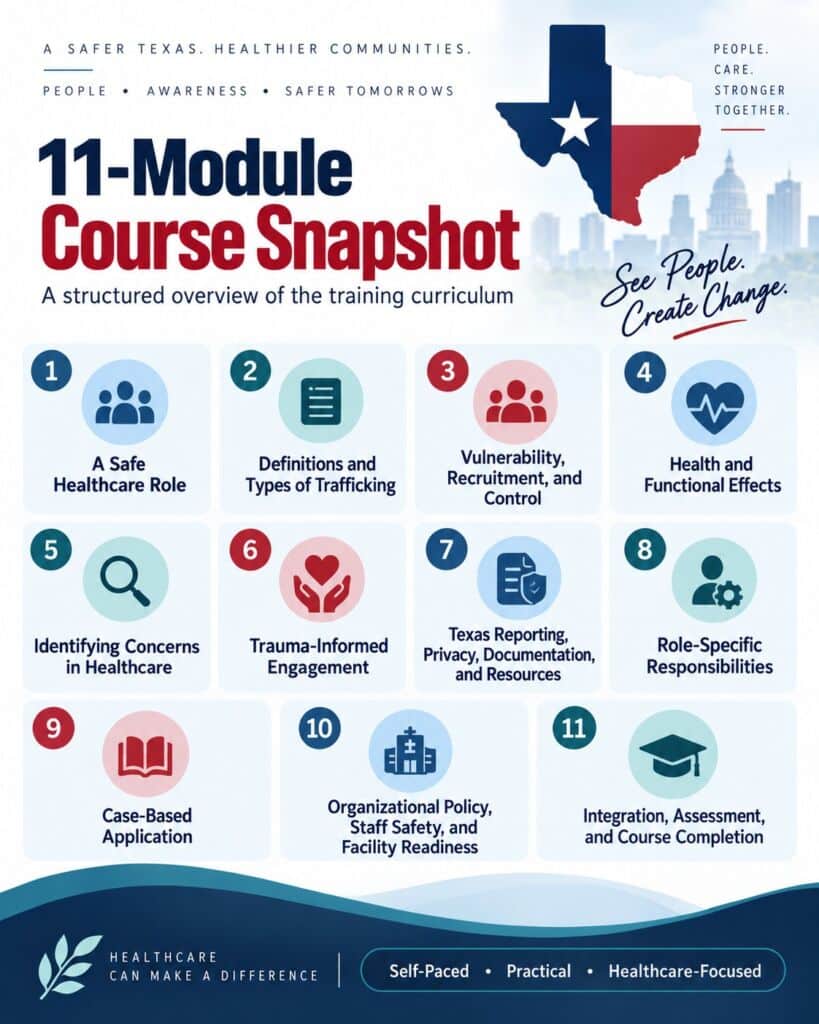
This online training includes 11 modules covering human trafficking awareness, healthcare response practices, privacy, reporting considerations, and organizational readiness.
Module 1: Understanding the Healthcare Role
Learn how healthcare personnel can respond to possible trafficking concerns within their professional responsibilities. Topics include urgent care, privacy, internal response procedures, professional boundaries, and actions that may increase risk.
Module 2: Definitions and Types of Human Trafficking
Explore sex trafficking, labor trafficking, force, fraud, coercion, and the commercial sexual exploitation of minors. Understand how trafficking differs from human smuggling and other forms of exploitation.
Module 3: Vulnerability, Recruitment, and Control
Understand how personal circumstances and unmet needs may be exploited through employment, housing, relationships, transportation, or online contact. Topics include threats, isolation, debt, withheld wages, and control over documents, technology, medication, and healthcare access.
Module 4: Health and Functional Effects of Trafficking
Explore potential physical, behavioral, occupational, and functional effects associated with exploitation. Topics include injuries, chronic health concerns, reproductive health needs, trauma responses, substance-related concerns, dental trauma, vision problems, and barriers to follow-up care.
Module 5: Recognizing Possible Concerns in Healthcare Settings
Learn how communication patterns, companion behavior, identification issues, payment arrangements, work conditions, living circumstances, and missed care may raise concerns.
Review privacy safeguards, professional interpretation, accessibility, digital privacy, and the limitations of screening tools.
Module 6: Trauma-Informed Engagement and Safe Communication
Learn how to use the SAFE CARE response model to organize urgent care, privacy, confidentiality, permission-based communication, focused assessment, appropriate action, patient choice, resources, and documentation.
Explore how to respond when a patient declines assistance or cannot communicate privately.
Module 7: Texas Reporting, Patient Privacy, and Documentation
Review the course’s guidance on reporting considerations for children, older adults, qualifying adults with disabilities, and other competent adults.
Explore HIPAA considerations, secure information sharing, law enforcement coordination, objective documentation, safe referrals, and protected follow-up communication.
Understand how clinicians, support personnel, social services, security, and leadership contribute to a coordinated response.
Learn how to recognize the boundaries of each role and when to escalate concerns through approved organizational procedures.
Module 9: Case-Based Learning and Practical Application
Apply course concepts to healthcare scenarios involving urgent medical needs, companion control, occupational concerns, dental and vision care, monitored telehealth, and an adult who declines additional assistance.
Practice choosing responses that account for privacy, safety, patient autonomy, and reporting responsibilities.
Module 10: Organizational Policy, Staff Safety, and Facility Readiness
Explore the elements of a healthcare response policy, including defined responsibilities, response levels, backup contacts, secure communication, companion management, and after-hours procedures.
Module 11: Knowledge Integration and Course Completion
Bring together the course concepts into a coordinated response approach.
Review common response errors and reinforce the relationship between recognition, urgent care, private communication, reporting considerations, patient autonomy, documentation, resources, and follow-up.
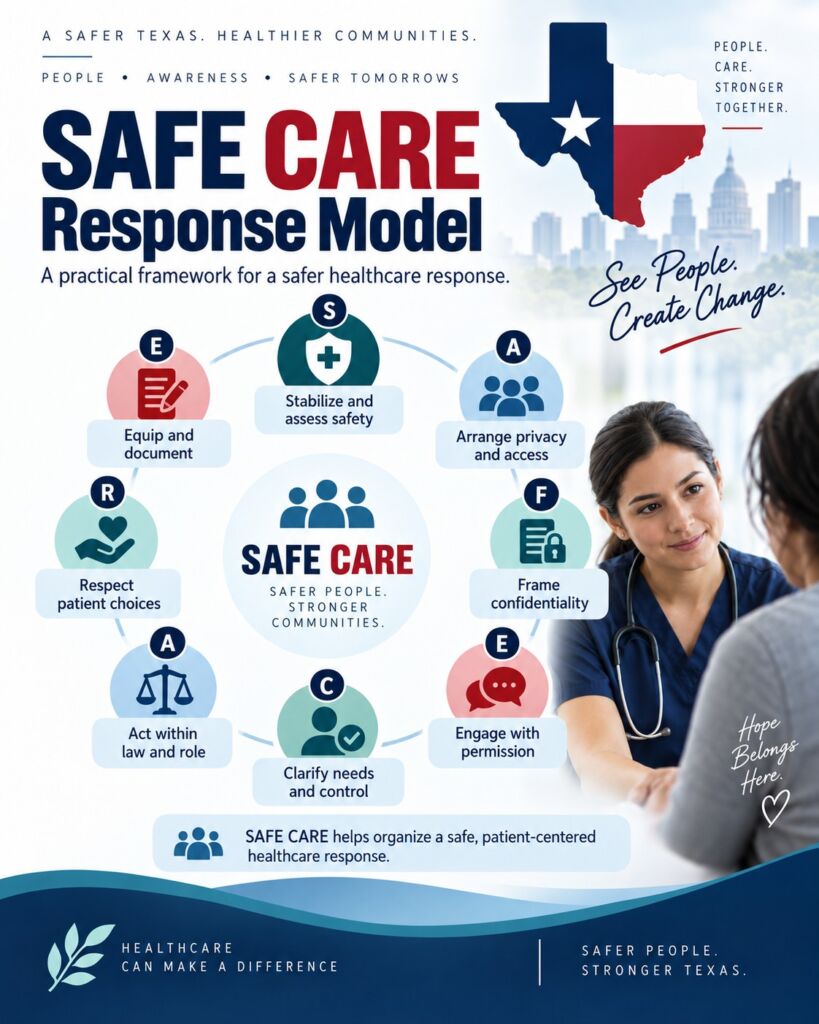
Learn the SAFE CARE Response Model
The course introduces SAFE CARE, a structured response model designed to help healthcare personnel organize safer, patient-centered encounters when trafficking concerns arise.
Step
Response Principle
S
Stabilize and assess safety
A
Arrange privacy and access
F
Frame confidentiality
E
Engage with permission
C
Clarify needs and control
A
Act within law and role
R
Respect patient choices
E
Equip and document
SAFE CARE is a course-specific response framework, not a diagnostic tool or a rigid interview script. The sequence may change depending on medical urgency, patient safety, age, capacity, and applicable reporting responsibilities.
Practical Training for Real-World Healthcare Encounters
Human trafficking awareness requires more than recognizing warning signs. Healthcare personnel also need to understand how to respond without compromising privacy, trust, or safety. This course connects learning with practical situations that may arise during everyday healthcare interactions.
Responding to a Controlling Companion
Protecting Patient Privacy
Supporting Patients Who Decline Assistance
Recognizing Concerns Across Healthcare Settings
Coordinating a Healthcare Response
Course Details and Enrollment
Course Information
Details
Course Name
Texas Human Trafficking Prevention and Safe Response for Healthcare Professionals
Course Price
$4.95
Training Format
Self-paced online training
Estimated Duration
150–180 minutes (2.5–3 hours)
Primary Audience
Clinical and nonclinical healthcare personnel
Main Topics
Sex trafficking, labor trafficking, trauma-informed care, privacy, reporting considerations, documentation, and referrals
Course Framework
SAFE CARE response model
Approval Status
HHSC approval and professional continuing education credit have not been confirmed for this course version
Build your knowledge of human trafficking awareness, patient-centered communication, and safer healthcare response practices with this affordable online training course.
It is an online educational course that helps healthcare personnel understand possible human trafficking indicators, trauma-informed communication, patient privacy, reporting considerations, and appropriate responses within healthcare settings.
Yes. The course covers sex trafficking and labor trafficking, including definitions, recruitment, coercive control, potential health effects, possible indicators, and safer healthcare responses.
The course is designed for clinical professionals, nonclinical support personnel, healthcare administrators, compliance teams, and other employees who may encounter patients experiencing exploitation.
Yes. The training includes guidance for front desk, scheduling, registration, billing, transportation, security, and other support staff. It focuses on observation, privacy, and appropriate escalation rather than independent investigation.
Yes. The curriculum includes case-based learning involving urgent care, occupational injuries, dental and vision care, potentially monitored telehealth, companion control, and patients who decline further assistance.
SAFE CARE is a course-specific framework for organizing safer healthcare encounters. It covers safety, privacy, confidentiality, permission-based engagement, clarification of needs, appropriate action, patient choice, resources, and documentation.
Yes. The curriculum reviews reporting considerations for different patient populations and discusses privacy, documentation, and appropriate escalation. Specific reporting obligations depend on the circumstances and applicable law.
The course discusses HIPAA-related privacy considerations in the context of responding to possible trafficking concerns. It should not be represented as a comprehensive HIPAA compliance course unless the course content and scope support that claim.
HHSC approval and professional continuing education credit have not been confirmed for this course version. Do not rely on it for license renewal or CE/CME requirements unless approval for the exact course version and applicable credit have been verified.
No. The course provides educational guidance. Healthcare organizations should maintain appropriate policies, response procedures, reporting protocols, and staff responsibilities based on applicable law and organizational requirements.
The course is designed for clinical and nonclinical healthcare personnel. Organizations should evaluate the course content against their own training requirements, policies, and applicable legal obligations before adopting it for formal staff training.
Use the Enroll Now for $4.95 button to access the course enrollment process. Review the course details and approval notice before purchasing.
Build Your Knowledge of Safer Healthcare Responses
Recognizing possible human trafficking concerns and responding appropriately can be an important part of patient-centered healthcare.
With Texas Human Trafficking Prevention and Safe Response for Healthcare Professionals, you can explore practical approaches to recognizing concerns, protecting patient privacy, communicating respectfully, and understanding your role in a coordinated response.